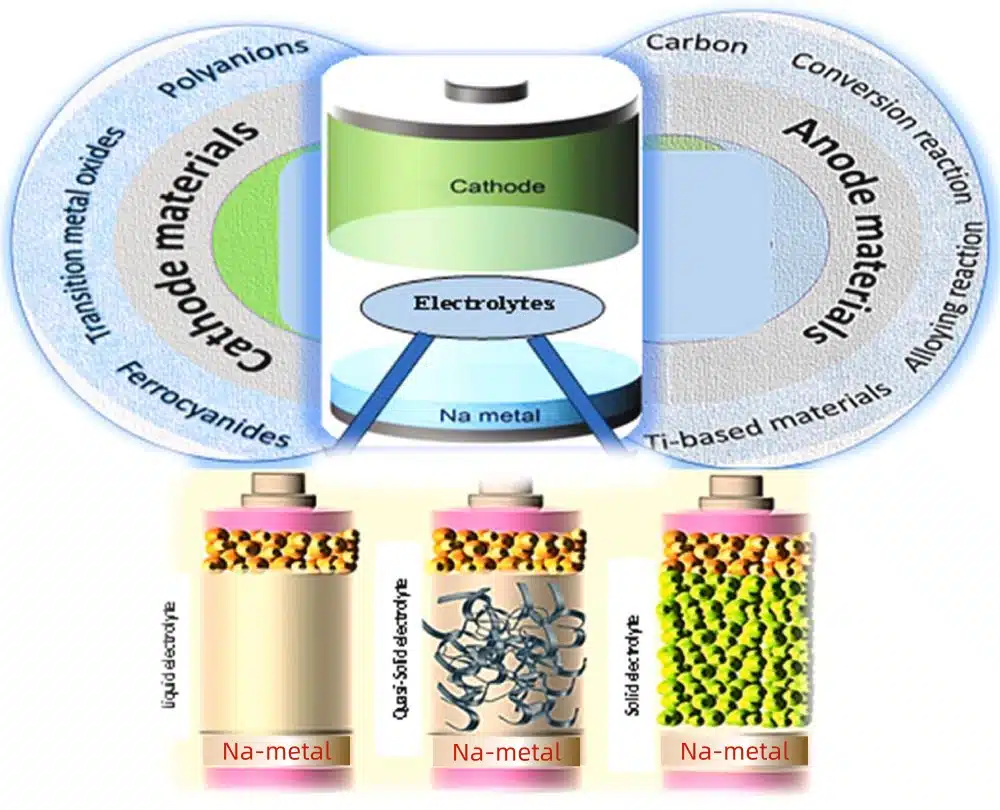
Sodium-ion batteries (SIBs) are moving from laboratory curiosity to industrial reality at a surprising pace. The raw material costs of SIBs are structurally lower than lithium-ion chemistries. SIBs are positioned to take a significant share of the stationary energy storage and low-speed electric vehicle markets. This article provides a detailed technical analysis of how sodium-ion battery mass production is forcing an upgrade in dry grinding capabilities. At EPIC Powder Machinery, we have been working with advanced battery material manufacturers on exactly this problem. What the material requirements demand, what the current technology bottlenecks are, and what the solutions look like at production scale.
But the commercial success of sodium-ion batteries will not be determined by electrochemistry alone. It will be decided in large part by the quality and cost of powder processing. Specifically, by how well manufacturers can grind, classify, modify, and handle active materials without compromising purity, performance, or production economics. And at the centre of that challenge is dry grinding technology.
Why Sodium-Ion Battery Mass Production Is Forcing Dry Grinding Upgrades
The shift from lithium-ion to sodium-ion chemistry is not simply a raw material substitution. The active materials used in SIBs have fundamentally different physical properties from their lithium-ion counterparts. Those differences translate directly into new requirements — and in some cases entirely new approaches — for powder processing.
The Material Property Challenge: Polyanionic Cathodes
Polyanionic compounds are currently the preferred cathode chemistry for energy storage applications due to their structural stability and cycle life. However, they present a significant processing challenge. It’s relatively high Mohs hardness, dense crystal structures, and sensitivity to surface chemistry. This makes contamination during grinding directly and measurably damaging to electrochemical performance.
Wet bead milling can achieve the nano-scale particle sizes these materials require, but at a significant cost: wear from grinding media introduces iron and zirconium contamination at the ppm level, and the subsequent spray drying step consumes 30–40% of total process energy while introducing the risk of agglomerate formation. For a battery chemistry whose primary market proposition is low cost, a high-energy-consumption, contamination-prone processing route is a fundamental contradiction.
Dry grinding — primarily jet milling and high-energy mechanical milling — addresses both problems simultaneously. No liquid medium means no dissolution of metallic ions from grinding media. No drying step means no agglomerate formation and no associated energy cost. The trade-off is that dry grinding requires more careful control of particle size distribution and surface area than wet processes. The equipment specification must be matched precisely to the material.
The Material Property Challenge: Hard Carbon Anodes
Hard carbon is the commercial anode of choice for sodium-ion batteries. Its disordered turbostratic structure provides the interlayer spacing and surface defect sites that sodium-ion storage requires. However, those same structural characteristics make it exceptionally sensitive to processing conditions.
Hard carbon precursors become brittle after carbonisation at 1,000–1,400°C, which makes grinding straightforward in terms of energy. What is not straightforward is controlling the outcome. Wet grinding of hard carbon causes two distinct problems: excessive oxidation of surface functional groups (which shifts the sodium storage mechanism and reduces initial Coulombic efficiency), and surface area explosion from particle fracture (which increases irreversible capacity loss in the first charge cycle). Every 1 m²/g increase in BET surface area above the target typically reduces first-cycle Coulombic efficiency by 0.3–0.8 percentage points — a significant performance penalty at scale.
Dry grinding under controlled atmosphere conditions — particularly with inert gas protection at low temperature — prevents surface oxidation of freshly fractured hard carbon surfaces and enables precise control of particle sphericity and size distribution. The result is a powder with the specific surface area, pore structure, and surface chemistry that optimises SEI film formation and initial Coulombic efficiency.
The Cost and Energy Efficiency Imperative
The cost logic of sodium-ion batteries is straightforward: raw material savings over lithium-ion are real and substantial. However, they are easily eroded by processing inefficiency. Wet processing routes can consume 30–40% of total manufacturing energy for the electrode preparation stage alone. For a battery technology that must compete on cost per kWh with established lithium iron phosphate (LFP) cells, this is not a sustainable processing baseline.
The push towards dry electrode technology, which is accelerating in the SIB field from 2025–2026, reinforces this direction. Dry electrode processing requires active materials to be delivered as dry powders with specific surface activity, particle size gradients, and fibrillation compatibility — characteristics that must be engineered into the powder at the grinding stage, not added afterwards. This directly defines the specification that upstream dry grinding must deliver.
| Key Dry Grinding Requirements Imposed by SIB Mass Production Polyanionic cathodes: Zero metallic contamination | D50 1–5 μm | Narrow PSD for bimodal blending Hard carbon anodes: Atmosphere-controlled grinding | Controlled BET surface area | Minimal surface oxidation Layered oxide cathodes: Ceramic-lined equipment | Low-temperature processing | D50 5–15 μm Dry electrode compatibility: Specific surface activity | Controlled particle size gradient | Solvent-free output |
Dry Grinding Technology Upgrades for Sodium-Ion Battery Production Lines
In the context of SIB mass production, dry grinding is no longer a standalone unit operation producing powder of a given size. It is evolving into an integrated system combining ultra-fine grinding, atmosphere control, surface modification, and particle shaping in a single continuous process. The following sections describe the specific technology upgrades that are defining the state of the art.
From Simple Grinding to Gas-Solid Synergistic Surface Modification
The most significant conceptual shift in dry grinding for battery materials is the recognition that the grinding step can be used to simultaneously modify the powder surface — not just reduce particle size. High-speed airflow in jet mills generates both shear forces and localised thermal energy that can activate surface reactions under controlled conditions.
- In-situ conductive coating: by introducing conductive agents (carbon nanotubes, Super P carbon black) into the grinding circuit alongside the active material, the shear and impact energy of the process physically coats active material particles with a uniform conductive layer. Research published in 2024 demonstrated that constructing a ‘point-line’ CNT-carbon black synergistic conductive network via this dry compounding route significantly enhances the rate capability of thick electrodes (>20 mg/cm²), directly addressing the sluggish sodium-ion diffusion kinetics that limit thick-electrode SIB cells.
- Surface passivation of hard carbon: by controlling the grinding atmosphere (inert gas, low temperature), freshly fractured hard carbon surfaces are prevented from reacting with atmospheric oxygen or moisture before they can be collected and passivated. This preserves the optimal surface chemistry for SEI film formation and delivers measurable improvements in initial Coulombic efficiency compared to air-atmosphere grinding.
- Moisture-controlled processing: layered oxide cathode materials (particularly O3-type sodium transition metal oxides) are moisture-sensitive — surface reaction with atmospheric water forms NaOH and Na₂CO₃ impurity phases that degrade cycle life. Dry grinding in a low-humidity or inert atmosphere environment eliminates this degradation pathway at the most vulnerable point in the process: when particle surface area is at its maximum immediately after grinding.
Bimodal Particle Size Distribution Control for Higher Compaction Density
Electrode compaction density — the mass of active material per unit volume of electrode — is one of the primary determinants of volumetric energy density in SIB cells. Increasing compaction density is therefore a direct route to increasing energy density without changing the cell chemistry.
The most effective strategy for maximising compaction density is a bimodal (or multimodal) particle size distribution, where large particles provide structural packing and fine particles fill the interstitial voids between them. The challenge is that a single grinding process cannot simultaneously optimise for both large and small particle populations with the precision required.
The solution being adopted in advanced SIB production lines is a series-connected grinding and classification architecture:
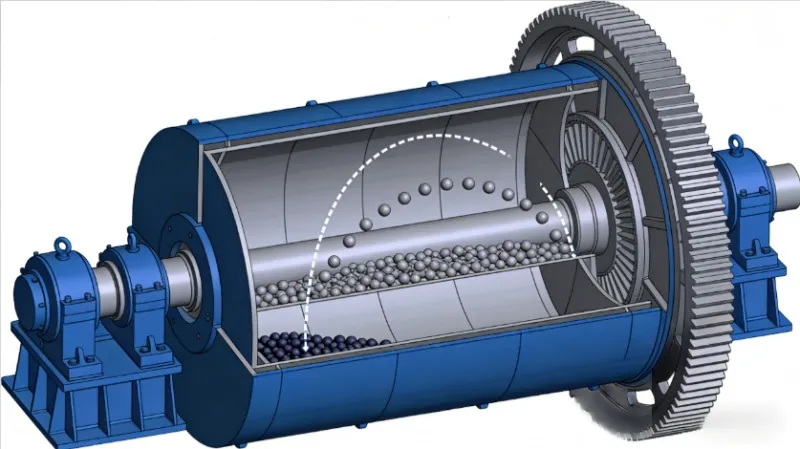
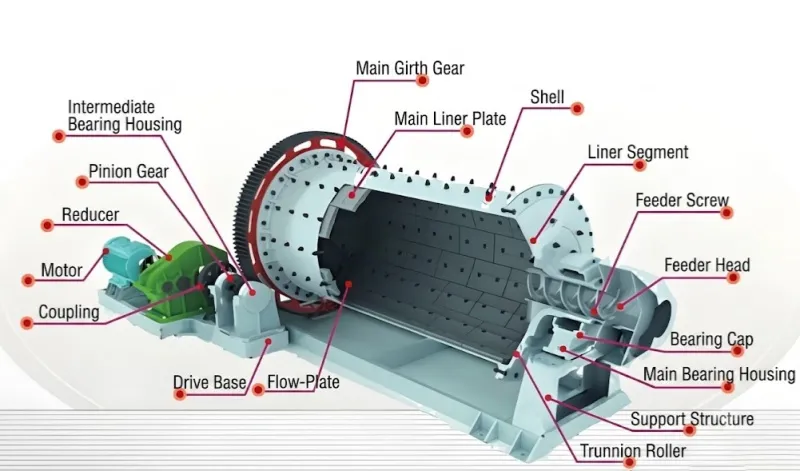
- Stage 1: a mechanical mill (ring roller or ball mill) produces a base powder with a broad size distribution centred around the target large-particle D50 (typically 10–20 μm for cathode materials).
- Stage 2: a portion of the base powder is diverted to a jet mill or stirred ball mill for further refinement to D50 2–5 μm, producing the fine fraction.
- Stage 3: a high-precision turbo classifier performs precise size separation on both streams, producing sharp particle size distributions that meet the bimodal blending specification.
- Stage 4: the coarse and fine fractions are blended at the optimised mass ratio to achieve the target bimodal distribution and maximum packing density.
This process architecture has been shown to increase electrode compaction density by 15% or more compared to conventional monomodal powder. It’s with a directly proportional improvement in volumetric energy density. The precision of the classifier — specifically its ability to make a sharp cut between the coarse and fine populations with minimal overlap — is the critical variable in this process.
Zero-Contamination Equipment Design: Ceramic Linings and Metal-Free Processing
Sodium-ion batteries have a modestly higher tolerance for trace metallic impurities than lithium-ion cells, but this tolerance has clear limits. Iron, chromium, and nickel contamination above threshold levels remain primary causes of self-discharge and, in long-cycle energy storage applications (>5,000 cycles), contributors to thermal runaway risk.
The industry response is a comprehensive shift to ceramic-lined and metal-contact-free dry grinding equipment. In practice, this means:
- Alumina or silicon carbide grinding chamber linings: replacing carbon steel or stainless steel contact surfaces, eliminating Fe and Cr as contamination sources from the mill body itself.
- Ceramic classifier wheels and guide vanes: since the classifier is the highest-wear component in an air classification system and operates in continuous contact with the finest (most contamination-sensitive) fraction of the powder.
- Non-metallic conveying and collection systems: including PTFE-lined pipework and ceramic-coated cyclones and bag filters, extending the zero-contamination philosophy through the entire powder handling circuit.
- Online metal detection and rejection: inline magnetic separators and eddy current separators positioned at the mill discharge to intercept any contamination particles before they reach the product collection vessel.
| Technology Upgrade | Problem It Solves | Key Specification | Production Impact |
| Inert gas jet milling | Surface oxidation of hard carbon and layered oxides | O₂ < 100 ppm in grinding circuit | +2–5% initial Coulombic efficiency |
| In-situ dry conductive coating | Slow rate capability in thick electrodes | CNT/Super P co-grinding with active material | Rate capability improvement at >20 mg/cm² |
| Series classifier + mill architecture | Low compaction density (monomodal PSD) | Bimodal D50 ratio typically 4:1 to 8:1 | +15% compaction density vs. monomodal |
| Ceramic-lined equipment | Fe/Cr/Ni contamination from mill surfaces | Total metallic impurities <1 ppm at mill discharge | Cycle life preservation >5,000 cycles |
| Low-temperature cryogenic grinding | Thermal degradation of heat-sensitive precursors | Grinding temperature <40°C via LN₂ cooling | Preserves precursor crystal structure |
The Remaining Challenges: What the Industry Has Not Yet Solved
Despite significant progress, several technical challenges remain unsolved or inadequately addressed in dry grinding for SIB mass production as of 2025–2026. Manufacturers who resolve these issues first will hold a durable competitive advantage.
Throughput vs. PSD Control Trade-Off in High-Speed Classification
High-precision turbo classifiers can achieve sharp particle size cuts at the specifications bimodal distribution requires, but throughput drops sharply as cut precision increases. At production scale — where tens of tonnes per day of cathode powder must be processed — the capital cost and footprint of the classification equipment required to simultaneously achieve high throughput and tight PSD control is substantial. The industry needs classifiers that maintain sub-micron cut precision at significantly higher throughput than current equipment allows.
Powder Flowability at Ultra-Fine Particle Sizes
As SIB cathode materials are ground to D50 below 3 μm to meet dry electrode specifications, powder flowability degrades sharply. Van der Waals and electrostatic forces become dominant over gravity, causing powder bridging in hoppers and silos, inconsistent feeding to downstream equipment, and poor dispersibility in dry electrode mixing. Surface modification during grinding — adding small quantities of flow aids such as fumed silica or fatty acid derivatives in the grinding circuit — is one approach, but it must be validated for electrochemical compatibility before adoption.
Scale-Up of Inert Gas Grinding Systems
Lab-scale and pilot-scale inert gas grinding (argon or nitrogen atmosphere jet milling) is well-established. Scaling these systems to production throughputs of 1–5 tonnes per hour while maintaining oxygen concentrations below 100 ppm, managing gas consumption economically, and ensuring safe operation presents engineering challenges that are not trivial. Gas recycling systems and intelligent atmospheric monitoring are necessary additions that add cost and complexity to the production line.
Consistent Quality Across Long Production Runs
Grinding media wear (in stirred ball mills) and classifier wheel wear (in turbo classifiers) cause gradual PSD drift over extended production runs. In battery material production, where the PSD specification is tight and performance-critical, this drift can shift product from within-spec to out-of-spec without a visible change in process conditions. Automated in-line PSD monitoring — using laser diffraction or acoustic spectroscopy — combined with closed-loop control of classifier speed is the emerging solution, but it requires integration of instrumentation that most production lines currently lack.
Configure Your Sodium-Ion Battery Dry Grinding Line with EPIC Powder Machinery
The powder engineering requirements of sodium-ion battery mass production are specific, demanding, and evolving rapidly. Whether you are processing polyanionic cathode materials, hard carbon anodes, or layered oxide powders, the right dry grinding configuration — mill type, classifier, atmosphere control, lining material — determines the ceiling on your battery’s performance and the floor on your cost per kWh.
EPIC Powder Machinery’s engineering team specialises in dry grinding systems for advanced battery materials. We offer jet milling, high-precision turbo classifiers, and ceramic-lined zero-contamination processing lines. Lab-scale trials are available to validate powder specifications before full production investment.
→ Request a Free Process Consultation: www.epic-powder.com/contact
→ Explore Our Battery Material Grinding Systems: www.epic-powder.com
Frequently Asked Questions
Why is dry grinding preferred over wet bead milling for sodium-ion battery cathode materials?
Wet bead milling introduces two problems that are difficult to tolerate in SIB production. First, wear from zirconia or steel grinding media releases iron and zirconium ions into the slurry, contaminating the cathode material at the ppm level — a level that measurably affects cycle life. Second, the spray drying step required after wet milling consumes 30–40% of electrode preparation energy and risks agglomerate formation. Dry grinding — particularly jet milling — eliminates both problems: no liquid medium means no ionic contamination, and no drying step means lower energy cost and no agglomeration. For a battery chemistry competing on cost per kWh, this makes dry processing the structurally correct choice.
What is bimodal particle size distribution and why does it matter for SIB electrodes?
A bimodal particle size distribution means the powder contains two distinct particle size populations: large particles that form the structural packing of the electrode, and fine particles that fill the voids between them. This maximises electrode compaction density — the mass of active material per unit volume — which directly increases volumetric energy density. A series-connected classification and grinding architecture, where a mechanical mill produces the coarse fraction and a jet mill or stirred ball mill produces the fine fraction, allows precise control of both populations. Electrode compaction density improvements of 15% or more have been demonstrated with optimised bimodal distributions compared to conventional monomodal powder.
How does inert gas atmosphere grinding improve hard carbon anode performance?
When hard carbon is ground in air, freshly fractured surfaces immediately react with atmospheric oxygen and moisture. This process forms surface oxygen-containing functional groups (C=O, COOH, C-OH) that alter the sodium storage mechanism. These groups increase the irreversible sodium consumption in the first charge cycle, reducing initial Coulombic efficiency. Grinding under inert gas (argon or nitrogen) with oxygen below 100 ppm prevents this surface reaction. It reserves the surface chemistry that optimises SEI film formation. Improvements of 2–5 percentage points in initial Coulombic efficiency have been demonstrated for hard carbon processed under inert atmosphere compared to air-atmosphere grinding.
What equipment is needed to produce zero-contamination dry-ground SIB cathode powder?
A zero-contamination dry grinding line for SIB cathode materials requires:
(1) a jet mill or ceramic-lined stirred ball mill with no metal surfaces in contact with product;
(2) a ceramic-lined dynamic air classifier for precise PSD control;
(3) PTFE-lined or ceramic-coated conveying, cyclone, and bag filter systems;
(4) inline magnetic separation at mill discharge;
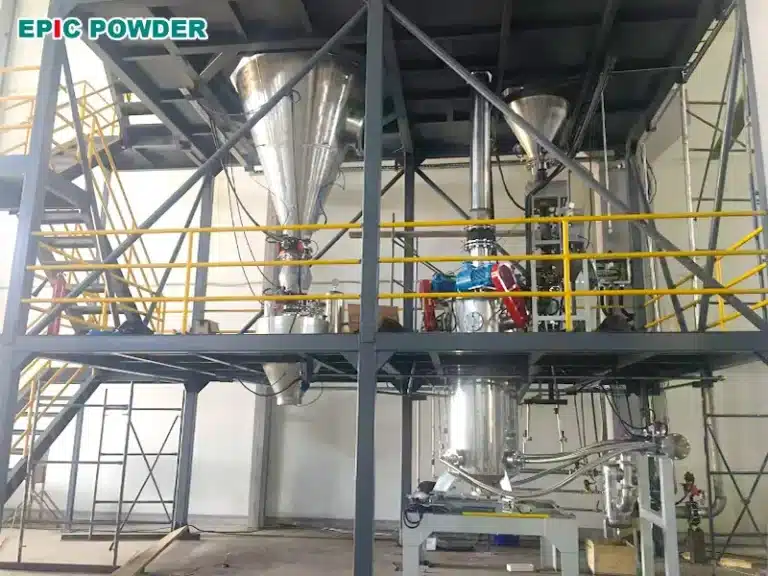
(5) for atmosphere-sensitive materials, a closed inert gas loop maintaining O₂ below 100 ppm throughout. EPIC Powder Machinery designs and supplies complete systems meeting these specifications.
How does dry electrode technology change the powder specification requirements for SIB active materials?
Dry electrode technology imposes specific powder requirements that differ significantly from conventional slurry-based electrode production. Active material powders must have: a specific surface area and particle size gradient that enables uniform mixing with PTFE binder. Sufficient surface activity to promote binder fibrillation under calendering pressure. A solvent-free, free-flowing particle form that processes consistently through dry mixing equipment. These requirements must be engineered into the powder at the grinding and classification stage — they cannot be added downstream.
Epic Powder
Epic Powder, 20+ years of work experience in the ultrafine powder industry. Actively promote the future development of ultra-fine powder, focusing on crushing, grinding, classifying and modification process of ultra-fine powder. Contact us for a free consultation and customized solutions! Our expert team is dedicated to providing high-quality products and services to maximize the value of your powder processing. Epic Powder—Your Trusted Powder Processing Expert!

“Thanks for reading. I hope my article helps. Please leave a comment down below. You may also contact EPIC Powder online customer representative Zelda for any further inquiries.”
— Jason Wang, Engineer