In the context of continuously advancing utilization of fly ash resources, the notion that “the finer, the more valuable” has become widely accepted across the industry. Whether used as a cement admixture, a concrete additive, or a high-end functional filler, increasing numbers of companies are treating fly ash grinding and ultrafine processing as the core direction of technological upgrading. But is finer fly ash always better? In the pursuit of higher fineness, are there hidden cost traps and performance misunderstandings? This article provides an in-depth analysis from multiple perspectives, including optimal fineness ranges, application scenarios, and grinding equipment selection.
I. The Fineness Myth: Is Finer Fly Ash Really Better?
At first glance, increasing the fineness of fly ash does bring several apparent benefits:
- Increased specific surface area and improved reactivity
- Enhanced filling effect and improved compactness
- Better dispersion and improved flowability
However, the assumption that “finer is always better” is a typical linear misconception. The performance improvement of fly ash does not increase indefinitely with fineness; instead, there exists an optimal range.
When fly ash becomes excessively fine, several issues may arise:
Significant Increase in Water Demand
Ultrafine particles have a much higher specific surface area, leading to increased water adsorption and higher water demand in concrete, which negatively affects workability.
Diminishing Returns in Reactivity Enhancement
The reactivity of fly ash originates from its glassy phase. Excessive grinding does not infinitely enhance reactivity and may even damage structural stability.
Increased Agglomeration
As particle size decreases, van der Waals forces between particles increase, making secondary agglomeration more likely and reducing effective dispersion.
Sharp Rise in Energy Consumption and Cost
Grinding to ultrafine levels results in exponential increases in energy consumption and severe equipment wear, reducing economic efficiency—one of the key risks in poorly optimized fly ash grinding systems.
Therefore, fineness should not be maximized blindly—it must be controlled appropriately.
II. Optimal Fineness Ranges for Different Applications
The “ideal fineness” of fly ash is not a fixed value; it depends on the specific application.
Cement and Concrete Applications
This is the most widely used field for fly ash.
- Conventional admixture:
Specific surface area of 300–400 m²/kg (10–20% residue on 45 μm sieve) - High-performance concrete:
400–600 m²/kg - Ultra-high-performance concrete (UHPC):
Up to 600–800 m²/kg
Beyond these ranges, performance gains are limited while costs increase significantly—especially when fly ash grinding is pushed beyond practical limits.
Dry Modification and Functional Fillers
In plastics, rubber, and coatings:
- Recommended particle size: D50 = 5–15 μm
- If too fine (<3 μm), it may cause:
- Poor dispersion
- Reduced processing flowability
- Difficulty in surface modification
High-End Applications (e.g., Cenospheres, Geopolymers)
These applications are more sensitive to particle size distribution rather than absolute fineness:
- Narrow particle size distribution is more important than ultrafine size
- Controlling coarse particles (>45 μm) is critical
III. The “Fineness Trap” in Grinding Equipment: More Precision ≠ Better Results
In practice, many companies equate “more advanced grinding equipment” with “higher achievable fineness,” leading to blind investment upgrades in fly ash grinding lines. This is the root cause of the fineness trap.
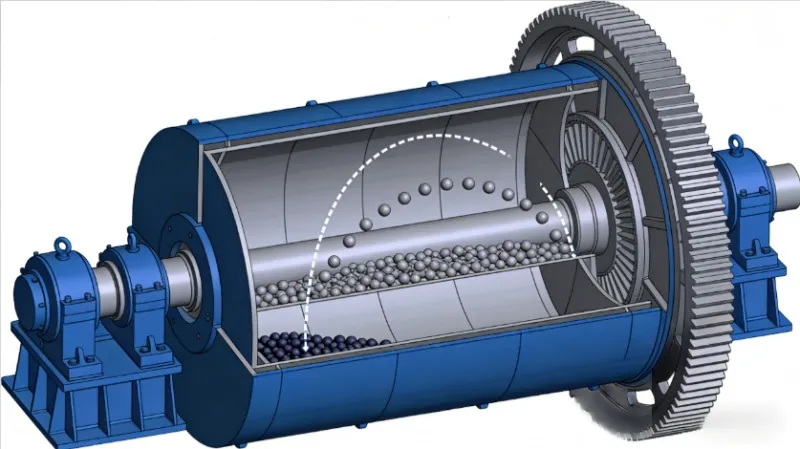
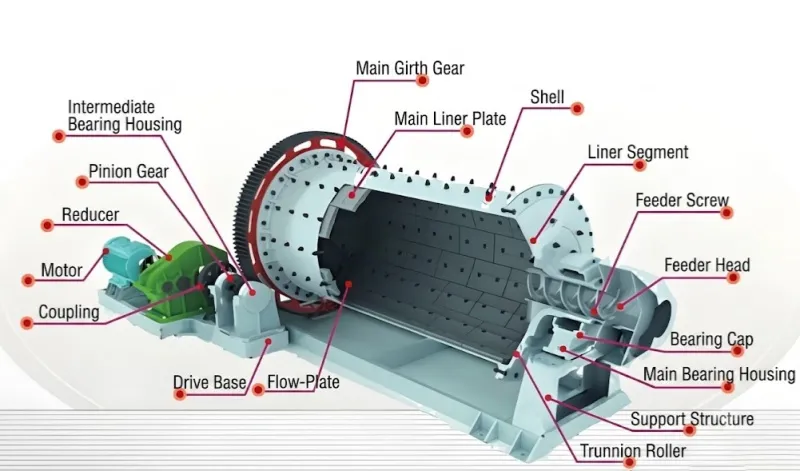
Ball Mill: Classic but Prone to Overgrinding
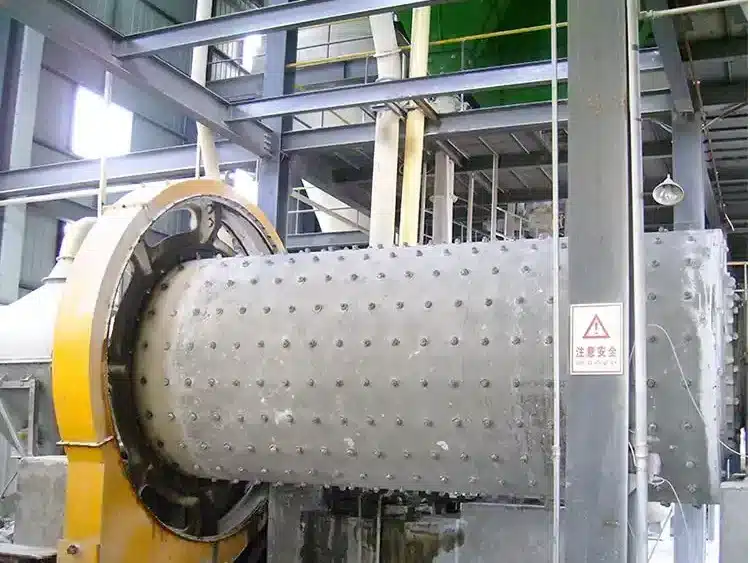
Characteristics:
- Combined impact and grinding action
- Wide particle size distribution
Challenges:
- Prone to overgrinding (excess ultrafine particles)
- High energy consumption
- Difficult to precisely control fineness
Suitable for:
Large-scale production of medium fineness (e.g., 400–600 m²/kg)
Vertical Mill (VRM): Energy-Efficient but Limited in Ultrafine Capability
Characteristics:
- Compression-based grinding
- Internal airflow classification
Advantages:
- Lower energy consumption
- Suitable for large-scale continuous production
Limitations:
- Difficult to stably produce ultrafine powders (<10 μm)
Suitable for:
Cement-grade fly ash production
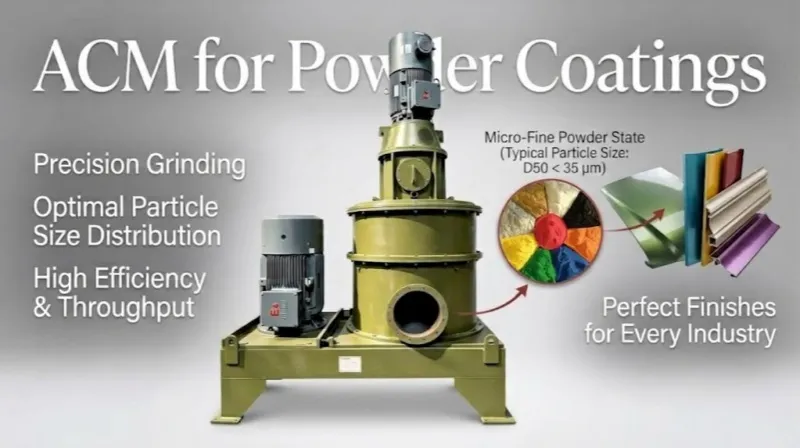
Air Classifier Mill: The Key to Precision Control
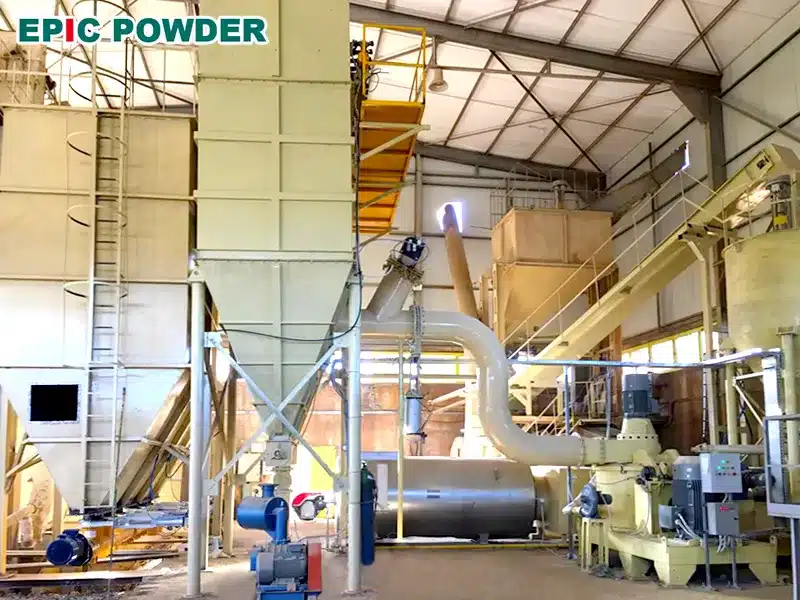
Characteristics:
- Integrated grinding and classification
- Precise control of particle size distribution
Advantages:
- Adjustable cut size
- Reduced overgrinding
- Narrow particle size distribution
Suitable for:
High-end fillers and modified fly ash
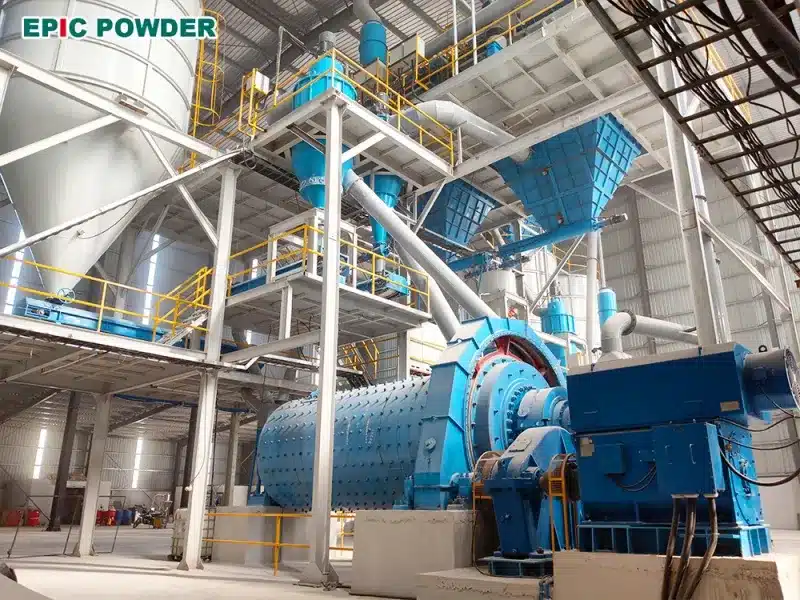
Ball Mill + Classification System: The Mainstream Solution
This is currently the most widely adopted optimization solution:
- Ball mill for grinding
- High-efficiency classifier for particle size control
Advantages:
- Prevents overgrinding
- Enables precise fineness control
- Improves energy efficiency
IV. How to Avoid the “Fineness Trap”: Three Key Strategies
Focus on Application Requirements, Not Equipment Limits
A common mistake is:
“If the equipment can grind finer, then go as fine as possible.”
The correct approach is:
Produce only as fine as required by the application.
Emphasize Particle Size Distribution, Not Just Fineness
Single indicators (such as specific surface area) cannot fully reflect performance. Greater attention should be paid to:
- D10 / D50 / D90
- Distribution width
- Coarse particle content
In many cases, a narrower distribution is more valuable than a finer average size.
Balance Energy Consumption and Cost Efficiency
Grinding costs mainly come from:
- Power consumption
- Grinding media consumption
- Equipment wear
When the benefit of increased fineness is lower than the added cost, the process has already fallen into the “fineness trap”—a common issue in inefficient fly ash grinding operations.”
V. Future Trend: From “Ultrafine” to “Precision Engineering”
With the advancement of powder processing technologies, fly ash treatment is shifting from “pursuing extreme fineness” to “precision control”:
- Tailored particle size distribution design
- Targeted surface modification
- Functional applications (e.g., reactivity tuning)
The future competition is no longer about:
👉 Who can grind finer
But rather:
👉 Who can achieve the best performance with the most appropriate fineness
Conclusion
Fineness is indeed an important factor influencing fly ash performance, but it is far from the only factor—and certainly not one that should be maximized without limits. Blindly pursuing ultrafine particles may not only fail to improve performance but can also significantly increase costs and negatively affect system stability.
The essence of the “fineness trap” lies in ignoring the balance between material application requirements and process economics.
Truly advanced powder processing is not about achieving the finest possible size, but about:
Optimal fineness + well-controlled particle size distribution + properly matched equipment and process.
Only in this way can fly ash truly transform from a bulk industrial by-product into a high-value resource.

“Thanks for reading. I hope my article helps. Please leave a comment down below. You may also contact Zelda online customer representative for any further inquiries.”
— Posted by Emily Chen