目次

ボールミル技術を用いて材料を効率的に超微粉砕するにはどうすればよいか?

With the rapidly increasing demand for fine particles in industries such as 食べ物, fine chemicals, and minerals, ultrafine grinding technology has attracted widespread attention. Common ultrafine grinding technologies include air jet milling, colloid milling, and ball milling. Among them, ボールミル technology utilizes mechanical energy and thermal effects to change the structure and properties of materials through friction, collision, and shearing. It has advantages such as sample stability, high processing quality, low cost, and environmental friendliness. It is widely used in crushing various minerals, food, pharmaceuticals, and chemical materials.

Ultrafine Grinding Ball Mill

I. Types of ボールミルズ

The operating principle of a ボールミル is primarily based on the material rotating around the mill’s rotating shaft, while the support disc rotates in the opposite direction. The combination of these two speeds generates centrifugal force. This causes the sample to undergo sufficient friction and shearing, thus achieving an ultrafine state.

Based on their working principles and characteristics, ball mills are generally classified into three types: stirred ball mills, vibratory ball mills, and planetary ball mills.

Vibratory Ball Mill:

A vibratory ball mill utilizes the high-frequency simple harmonic vibration of the cylinder. This drives intense impact, compression, and shear stress between the grinding media and the material, thereby achieving rapid refining and uniform mixing of the material. It can generally grind materials to the micron level.

Stirred Ball Mill:

A stirred ball mill uses a high-speed rotating agitator inside the mill to directly transfer powerful kinetic energy to the grinding media and materials. Under intense collision, friction, and shearing action, the materials are thoroughly pulverized. It offers advantages such as easy operation, simple structure, high pulverization rate, and low pollution. It is suitable for both wet and dry ball milling.

遊星ボールミル:

Planetary ball mills are used for sample processing, colloid grinding, and material development due to their good reproducibility, safe handling, and short processing time. It uses a transmission system to make the mill cylinder both revolve around a central axis and rotate on its own axis. This generates a powerful centrifugal force that pulverizes the materials. It features high impact velocity and high impact frequency.

II. Ball Milling Media

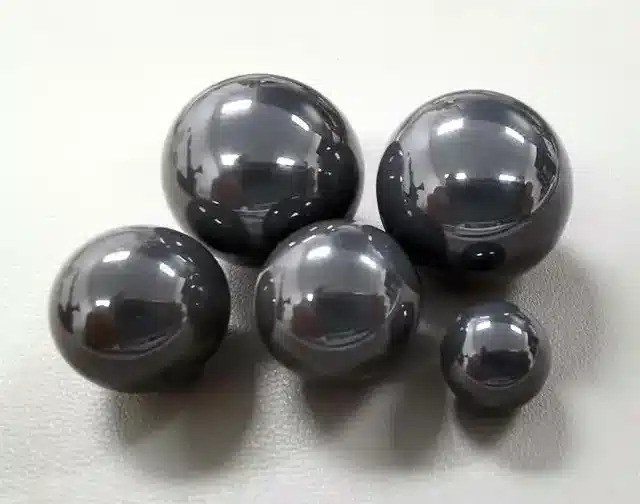
Silicon nitride grinding balls

Ball milling processes can be divided into dry and wet methods, depending on whether a liquid dispersion medium is added during the grinding process. Dry ball milling involves directly loading dry materials into the mill for grinding. It has advantages such as a short process flow, simple operation, and low energy consumption. Therefore, it is widely used in traditional fields such as grain processing.

Wet ball milling requires the addition of a dispersion medium to the material. It utilizes the friction, collision, and impact between the grinding media and the material to achieve pulverization. Although the process parameter control and operating conditions of wet ball milling are more complex, and grinding aids are often added to assist grinding, its equipment structure is relatively simple. And the product has good grinding uniformity. Whether dry or wet, the ultrafine grinding process can process food raw materials into powders of different particle sizes through powerful shearing, impact, and collision forces, thereby meeting diverse application needs.

III. Ball Milling Conditions

Ball mills come in various types. The ball milling effect is influenced by multiple factors, such as the density of the grinding material, the number and size of the grinding balls, the grinding speed, the grinding time, the grinding temperature, the ball-to-material ratio, and the filler ratio. Due to the combination of these variables, the energy provided by the ball mill varies greatly. If the grinding energy provided is low, only a reduction in particle size and an increase in specific surface area will occur. However, if the energy is very high (high-energy ball milling), the decomposition of chemical bonds and the occurrence of chemical reactions can be achieved. Therefore, the optimal grinding conditions must be determined according to the desired effect.

IV. Application Areas and Core Advantages of Ball Milling Technology

Due to its high energy efficiency and low cost, ball milling technology has been widely applied in several key industrial sectors:

  • Food and Agricultural Product Processing: Used for the ultrafine grinding of materials such as tea, grains, and chitin, significantly improving solubility, dietary fiber absorption, and texture.
  • Biomedicine and Health Products: Effectively breaks down the cell walls of traditional Chinese medicine herbs (cell wall disruption), promoting the dissolution of active ingredients and improving drug bioavailability.
  • Fine Chemicals and Mineral Materials: Used for the high-purity grinding and modification of battery positive and negative electrode materials, ceramic powders, and rare earth minerals.
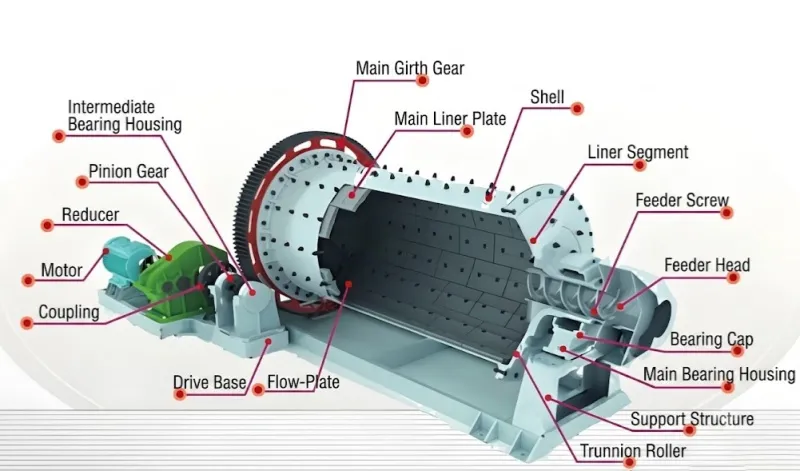
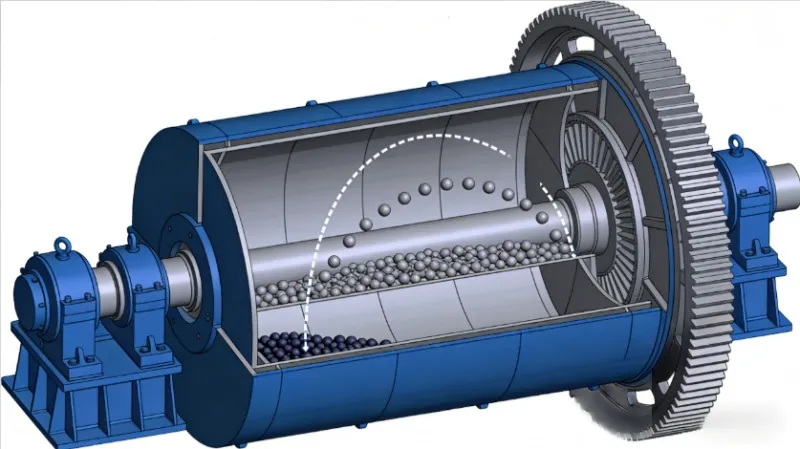
ボールミル構造
ボールミル構造

V. Core Process Parameters for Optimizing Ball Milling Effect

To achieve ideal particle size distribution and grinding efficiency, the following key parameters need to be carefully controlled:

Parameter NameMechanism of ActionOptimization Suggestions
Ball-to-Material Ratio (Medium to Material Mass Ratio)Determines the frequency of impact and friction during grinding.Common range is 5:1 to 20:1; higher ratios are recommended for high-energy grinding.
Filling Ratio (Total Grinding Volume Percentage)Affects the media movement space and energy transfer efficiency.Controlled to 30% – 50% of the grinding jar volume to avoid insufficient centrifugal force due to overfilling.
Grinding Ball Grading (Ratio and Size)Large balls provide impact force, small balls provide shear and friction force.A mixed ratio of large and small balls can balance coarse crushing and fine grinding.
Grinding Ball Grading (Ratio and Size)Determines the total input mechanical energy.The speed should reach 70% – 85% of the critical speed; excessive time can easily lead to secondary agglomeration of materials.

Mechanochemical Synthesis (High-Energy Ball Milling):

Utilizing extremely high energy to induce solid-phase chemical reactions, inorganic material synthesis and organic modification can be achieved without solvents.

Low-Temperature/Refrigerated Ball Milling Technology:

Introducing liquid nitrogen cooling to solve the problem of denaturation or melting of heat-sensitive materials (such as proteins, enzymes, and low-melting-point plastics) during the grinding process.

Intelligent and Continuous Production:

Combining online particle size monitoring and automated control systems. Promoting the transformation of ultrafine ball milling from batch processing to continuous and intelligent industrial production.


エミリー・チェン

“お読みいただきありがとうございます。この記事がお役に立てば幸いです。ご意見・ご感想は下のコメント欄にお寄せください。その他ご質問がございましたら、ゼルダのオンラインカスタマーサポートまでお問い合わせください。”

— 投稿者 エミリー・チェン
お問い合わせ

弊社の専門家が 6 時間以内にお客様に連絡し、機械とプロセスに関するお客様のニーズについてご相談させていただきます。

    あなたが人間であることを証明するために、 フラグ

    関連記事