In high-energy-density lithium-ion battery systems, ternary cathode materials (NCM/NCA) have become one of the mainstream choices for power batteries due to their high capacity and tunable structural advantages. However, an often overlooked fact is that the performance of ternary cathode material does not depend solely on chemical composition. Instead, it is highly determined by the level of powder engineering, especially the particle structure shaped by grinding and classification processes.
In other words, ternary materials are not simply “synthesized and completed”—they are truly “shaped within the grinding system.”
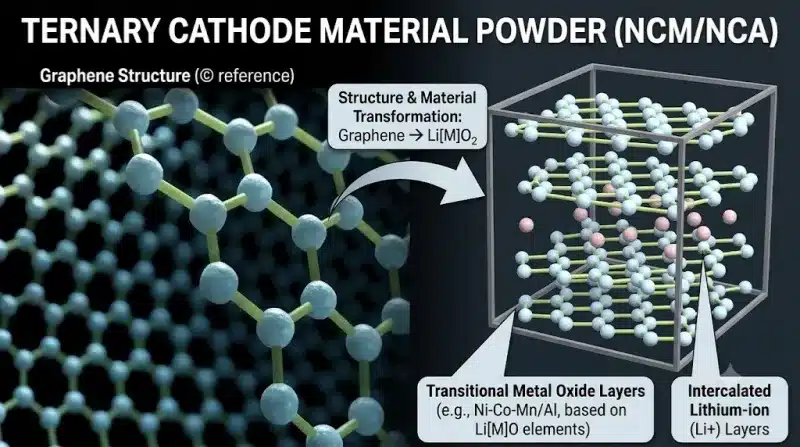
1. Complete Preparation Mechanism of Ternary Cathode Material via High-Temperature Solid-State Method
Industrial mainstream ternary materials are typically prepared through a four-step process: co-precipitation precursor synthesis → powder mixing with lithium → high-temperature solid-state calcination → post-treatment grinding and classification. The core chemical mechanism consists of two stages: liquid-phase precipitation and high-temperature solid-state transformation.
(1) Co-precipitation Mechanism of the Precursor
Using mixed nickel, cobalt, and manganese sulfate solutions as metal sources, sodium hydroxide as the precipitating agent, and ammonia water as the complexing agent, a co-precipitation reaction occurs under controlled pH, temperature, and stirring conditions:
xNi²⁺ + yCo²⁺ + (1 − x − y)Mn²⁺ + 2OH⁻ = NiₓCoᵧMn₁₋ₓ₋ᵧ(OH)₂↓
Metal ions are slowly released through ammonia complexation, and hydroxides precipitate uniformly to form spherical secondary precursor particles. The primary crystal size, sphericity, and microscopic elemental uniformity of these particles determine the final integrity of the cathode crystal.
If precursor particles are coarse or heavily agglomerated, and elemental segregation occurs, defects such as lithium–nickel mixing and local lithium deficiency will form after calcination, significantly reducing capacity and cycle life.
(2) Solid-State Activation Mechanism of Precursor Grinding and Lithium Mixing
After washing and drying, the precursor is mixed with lithium sources (Li₂CO₃ for low-nickel NCM, LiOH·H₂O for high-nickel NCM811/NCA) at a molar lithium ratio of 1.02–1.08. Grinding equipment is used to achieve mechanical activation and mixing.
The shear and impact forces generated during grinding break precursor agglomerates, reduce particle size, and increase specific surface area. At the same time, lithium salts are uniformly coated on the precursor surface, shortening lithium-ion diffusion distance during high-temperature reaction and lowering activation energy for solid-state reactions.
Mechanical-chemical effects can break surface passivation layers of particles, enabling uniform contact among Li⁺, Ni²⁺, Co³⁺, and Mn⁴⁺ at the microscale, thereby providing a uniform reaction interface for layered crystal growth.
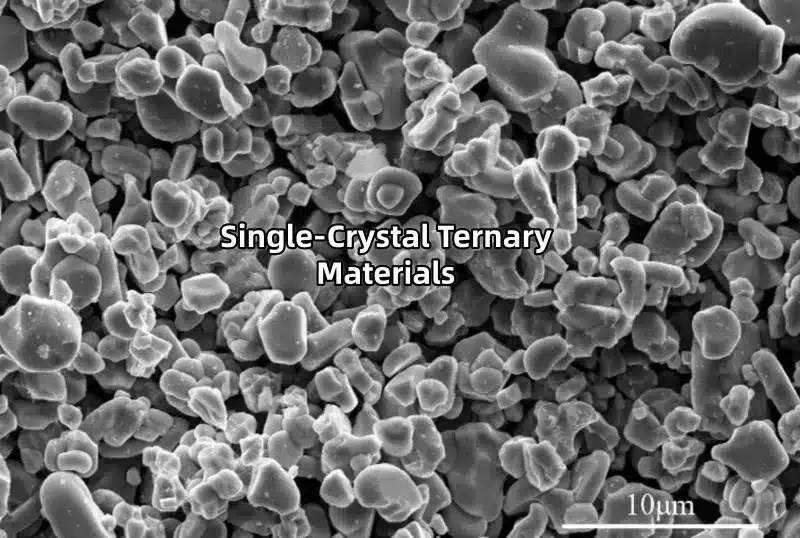
(3) High-Temperature Calcination and Crystal Transformation Mechanism
The mixed powder enters a roller kiln and undergoes a three-stage process: heating, holding, and cooling, completing solid-state oxidation reconstruction:
NiₓCoᵧMn₁₋ₓ₋ᵧ(OH)₂ + LiOH/Li₂CO₃ → LiNiₓCoᵧMn₁₋ₓ₋ᵧO₂ + H₂O/CO₂↑ (high temperature, oxygen atmosphere)
During the heating stage, hydroxides dehydrate and decompose, while lithium salts melt and penetrate into the interstitial spaces of the precursor lattice. During the holding stage, ion diffusion and layered crystal reconstruction occur, forming a well-ordered hexagonal α-NaFeO₂-type layered structure. During cooling, crystal ordering improves further, and primary crystals bond together into hard agglomerated calcined blocks.
Inside the calcined blocks, primary single crystals are tightly bonded, forming a macroscopic sintered mass. These must be broken and reshaped through multi-stage grinding before they can be used as electrode coating materials.
(4) Post-Calcination Grinding and Modification Mechanism
Calcined materials exhibit severe agglomeration, wide particle size distribution, and uneven surface residual alkalinity. Coarse crushing is used to break large aggregates, while ultrafine jet milling gently deagglomerates particles without grinding media contact, preserving single-crystal integrity.
The classification system precisely controls D50 at 1.5–3 μm, achieving a narrow particle size distribution that balances high tap density and lithium-ion transport efficiency. Meanwhile, magnetic removal processes eliminate metallic impurities introduced during grinding, preventing micro-short-circuit risks inside batteries.
2. Working Principles and Process Value of Grinding Equipment in Each Preparation Stage
The entire ternary preparation process includes four major grinding operations: precursor wet grinding, dry mixing and lithium grinding, calcined material coarse crushing, and final ultrafine grinding. These correspond to four core equipment types forming a complete powder control system.
(1) Horizontal Sand Mill: Wet Ultrafine Grinding of Precursors
In the precursor co-precipitation slurry stage, a horizontal zirconia sand mill is used. Inside the grinding chamber, 0.2–0.3 mm zirconia beads rotate at high speed with the stirring disk, generating high-frequency shear and impact.
The liquid medium prevents secondary agglomeration, reducing precursor D50 from 10 μm to 1–2 μm. Sand milling breaks hard agglomerates and eliminates local elemental enrichment. After spray drying, a precursor powder with higher sphericity and more uniform elemental distribution is obtained.
Compared with ball mills, sand mills offer continuous operation, higher throughput, and narrower particle size distribution, making them a standard device for wet precursor homogenization.
(2) Planetary Ball Mill: Laboratory / Small-Batch Dry Mixing Activation
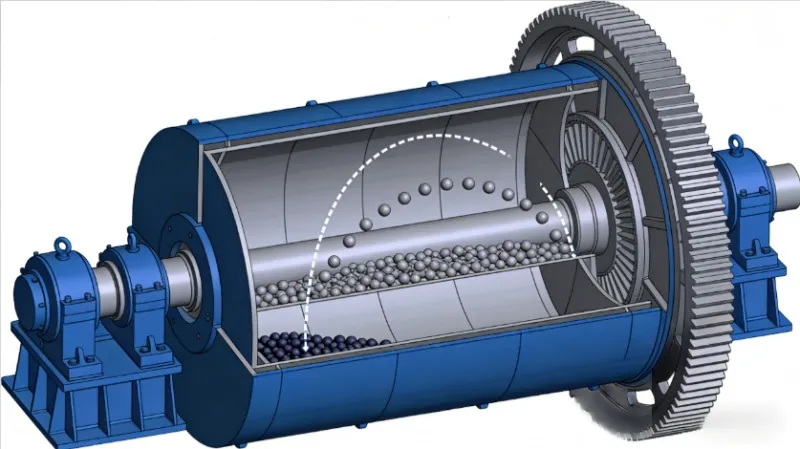
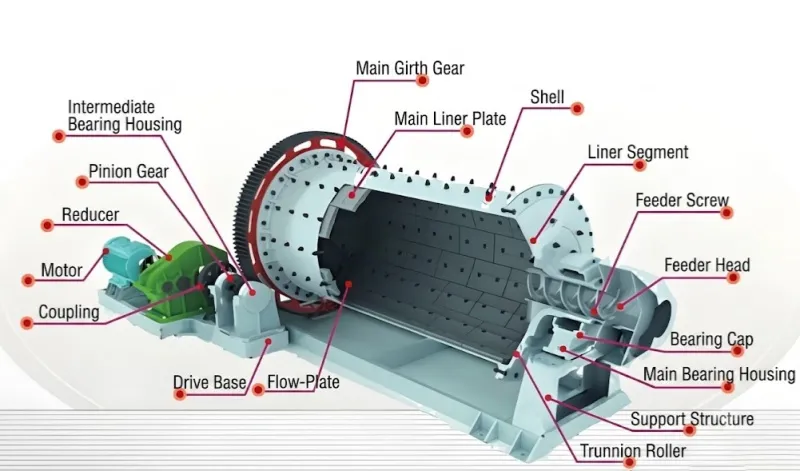
In R&D and pilot-scale lines, zirconia-lined planetary ball mills are used. The combined rotation and revolution generate centrifugal forces up to 20 times gravity. Grinding media perform high-energy mixing and fragmentation of precursor and lithium salt powders.
Dry milling provides mechanical activation, improving surface reactivity and solving poor interface contact between lithium salts and precursors. Fully ceramic liners prevent iron and chromium contamination, making it suitable for high-nickel NCA materials that are extremely sensitive to impurities.
However, due to batch operation limitations, it is mainly used for laboratory and pilot-scale development rather than mass production.
(3) Double-Roll Crushers / Ring Roller Mills: Coarse Crushing of Calcined Blocks
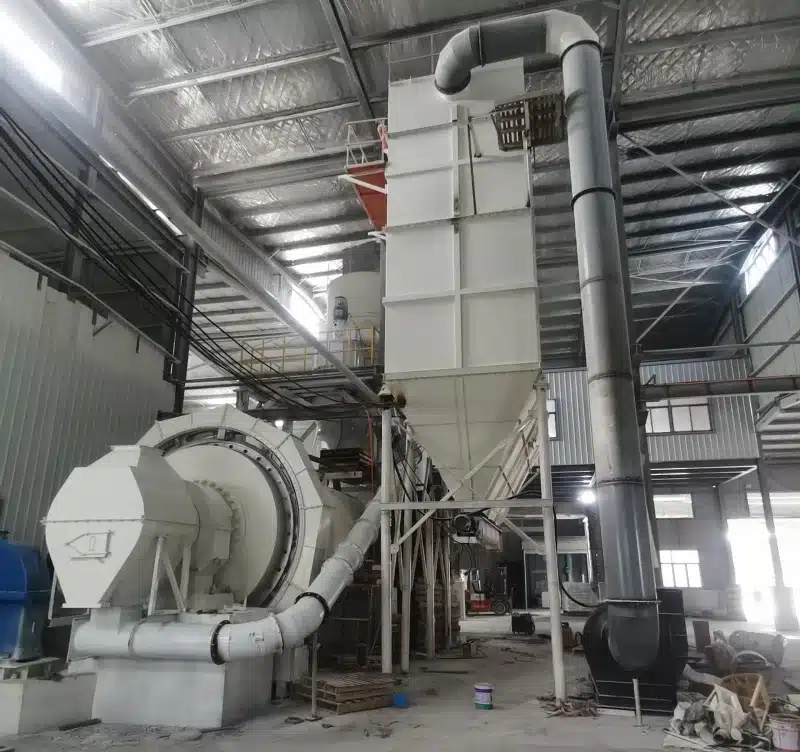
Calcined output is in the form of centimeter-scale hard blocks. Ceramic-lined double-roll crushers are used for primary crushing, reducing material size below 2 mm and breaking large agglomerates.
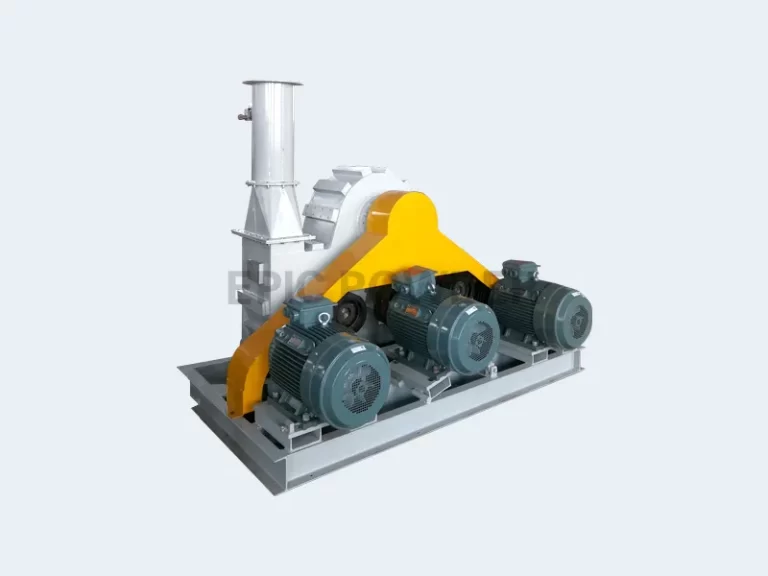
New ring roller mills use zirconia grinding plates for gentle deagglomeration. Compared with traditional jaw crushers, they cause less single-crystal damage and reduce magnetic impurity introduction by 60%, solving cracking and excessive fines issues in high-nickel single-crystal materials. This provides qualified feed for subsequent ultrafine jet milling.
(4) Fluidized Bed Jet Mill: Final Ultrafine Grinding and Classification
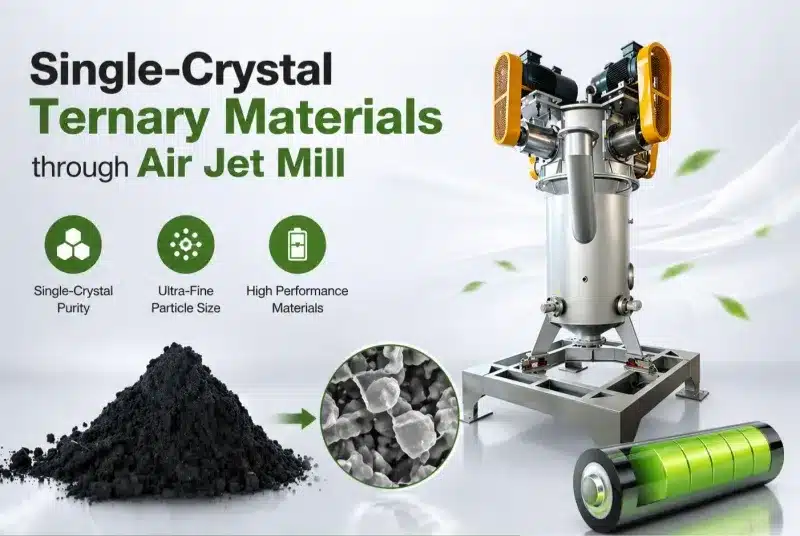
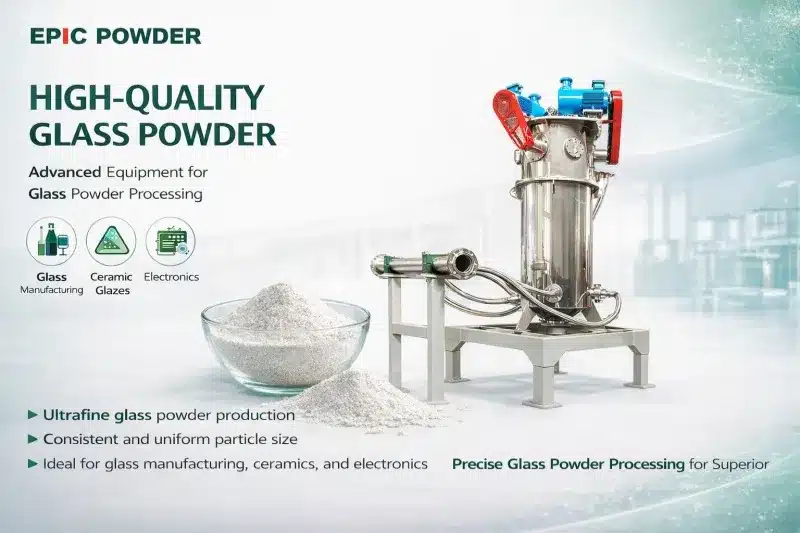
This is the core ultrafine grinding equipment for industrial production. High-pressure nitrogen (0.6–1.2 MPa) accelerates particles through nozzles, causing inter-particle collisions without grinding media contact.
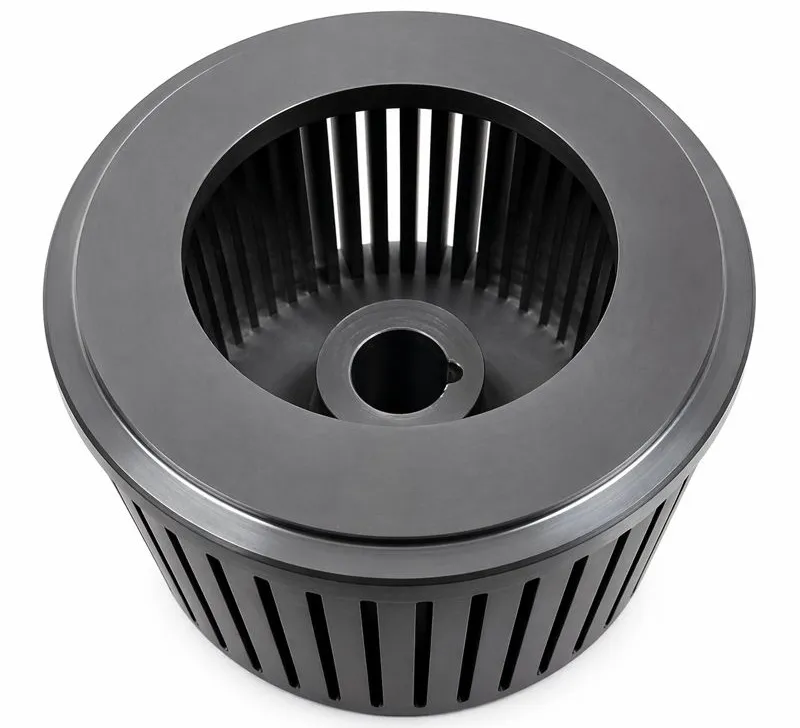
This maximally preserves the layered single-crystal structure and avoids lattice distortion and lithium–nickel mixing caused by ball milling shear. The built-in turbine classifier performs real-time screening, precisely controlling D50 and maintaining Span < 1.2.
The resulting powder exhibits stable tap density and compaction density, making it suitable for electrode coating in power batteries. It is the key equipment for final processing of ternary cathode material.
3. Frequently Asked Questions (FAQ)
Q1: Why must ternary cathode material undergo fine grinding instead of directly using calcined products?
Calcined ternary materials typically exhibit severe secondary agglomeration and uneven particle size distribution. Without grinding, this leads to:
- Non-uniform electrode coating
- Localized current density hotspots
- Structural cracking during cycling
The essence of grinding is not simply “size reduction,” but reconstructing a usable particle architecture system, ensuring electrochemical consistency.
Q2: Is jet milling always better than ball milling for ternary materials?
Not necessarily. The two are complementary:
- Ball milling: suitable for mixing, preprocessing, and deagglomeration (low cost)
- Jet milling: suitable for high purity and precise control (high performance)
High-end ternary materials typically adopt a combined process:
👉 “Ball milling preprocessing + jet fine grinding + classification control”
A single type of equipment cannot simultaneously meet requirements for cost, purity, and particle size control.
Conclusion
The performance competition of ternary cathode material is not merely a competition of chemical systems; fundamentally, it is a competition of powder engineering and grinding equipment capability.
From co-precipitation forming the precursor, to calcination constructing crystal structure, and finally to grinding systems reconstructing particle architecture, the entire process is a multi-scale synergistic optimization from chemistry to physics to particle engineering.
Whoever can precisely control the grinding process is closer to the core of next-generation high-energy-density battery materials.

“Thanks for reading. I hope my article helps. Please leave a comment down below. You may also contact Zelda online customer representative for any further inquiries.”
— Posted by Emily Chen