Electrostatic spraying of powder coatings entered practical applications in the 1960s and has gained growing popularity ever since. This growth is especially driven by increasingly strict environmental requirements worldwide regarding Volatile Organic Compound (VOC) emissions. As a 100% solid material, powder coatings offer high application efficiency as well as excellent protective and decorative qualities. Consequently, they have received widespread attention and rapid development, showing a clear trend toward replacing liquid paints and other volatile coating materials across many industries.
Why Are Particle Size and Distribution Key to Powder Usability?
As downstream application industries evolve, their performance expectations for powder coatings continue to rise. Beyond final film performance, applicators judge a powder primarily on application ease and aesthetic appeal. In other words, they care about whether the powder is “easy to apply” and yields “good leveling.”
This puts higher demands on the manufacturing process. Particle size and particle size distribution (PSD) are critical quality metrics. They directly affect fluidization, storage stability, electrostatic chargeability, film appearance, transfer efficiency, and powder utilization. Ultimately, these factors determine whether a powder coating is “easy to use.”
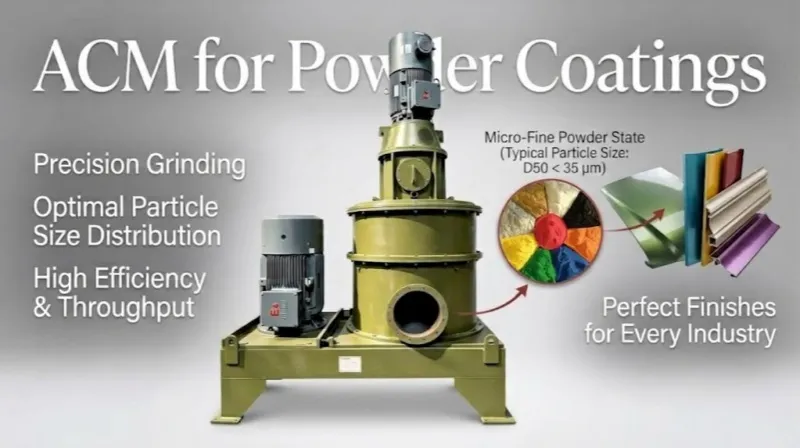
The particle size of a powder coating refers to the average diameter of irregular particles. After grinding in an ACM mill, the particles vary in size and follow a specific distribution.
How Do Particle Size and Distribution Impact Practical Application?
Specifically, powder particle size and distribution affect application performance in the following ways:
Impact on Transfer Efficiency: Particles that are either too coarse or too fine hinder deposition. Fine particles (below 10 µm) do not deposit easily due to poor electrostatic charging. Coarse particles (above 70 µm) fail to stay on the substrate because gravity overwhelms electrostatic forces.
Impact on Coating Thickness and Leveling: Smaller particle sizes generally improve film leveling. For a powder with an average particle size of D, the required coating thickness h usually needs to be between 2D and 3D to achieve a smooth finish.
Impact on Powder Stability: Higher proportions of fine particles (below 10 µm) reduce powder stability. Fine particles readily absorb moisture and form agglomerates. This leads to issues such as gun blockages and irregular powder spitting.
Impact on Powder Recovery: When the average particle size is too fine, or when the content of superfine powder (below 10 µm) is excessively high, the powder becomes difficult to recover and reuse.
Impact on Textured Finishes: The texture size of textured powders depends directly on particle size. For instance, the delicacy of sand-texture powders relies heavily on particle dimensions. Similarly, the pattern sizes of wrinkle, leatherette, or hammertone coatings containing internal texturing agents are influenced by grain size.
In summary, particle size and distribution directly dictate charging capacity, transfer rate, stability, film leveling, coating thickness, and texture patterns. Controlling PSD to minimize maximum particle size while keeping superfine content low has become increasingly crucial. The following sections examine how formulation, mill operating speeds, feeding rates, mill temperature, air airflow, cyclone separators, and particle shapes influence particle size and distribution.
How Do Grinding and Screening Parameters Control Particle Size?
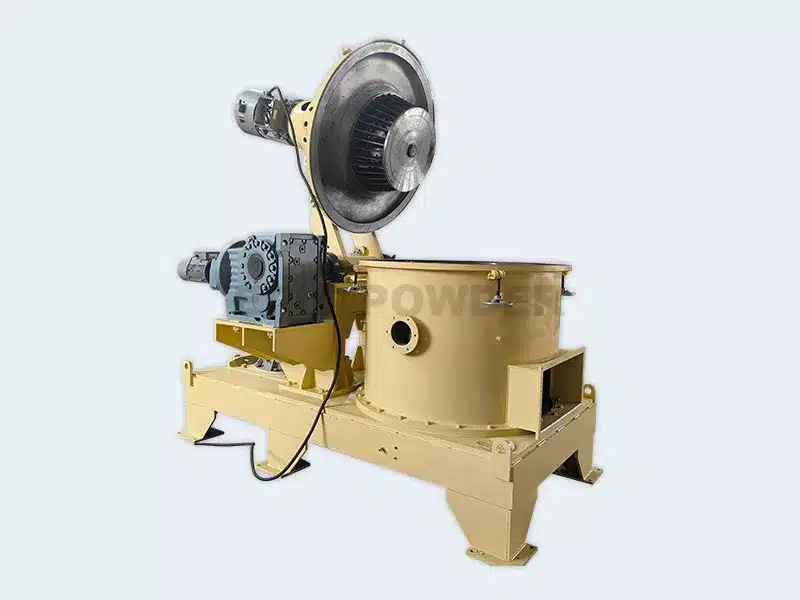
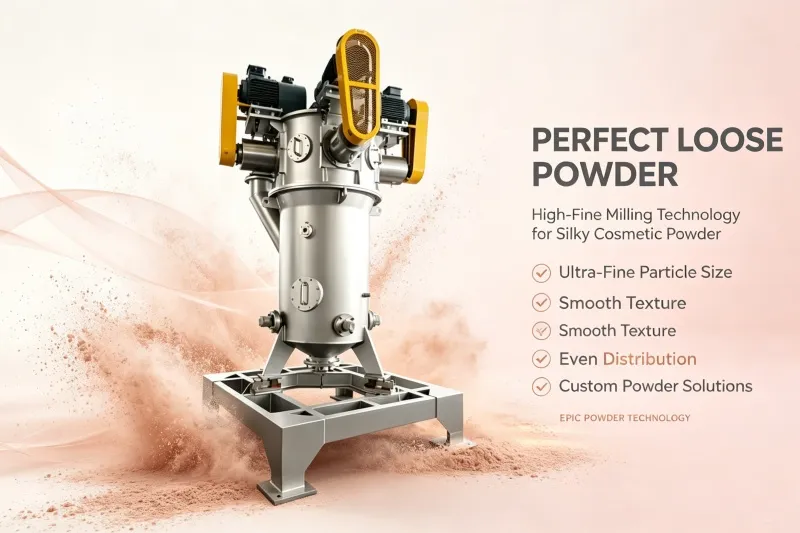
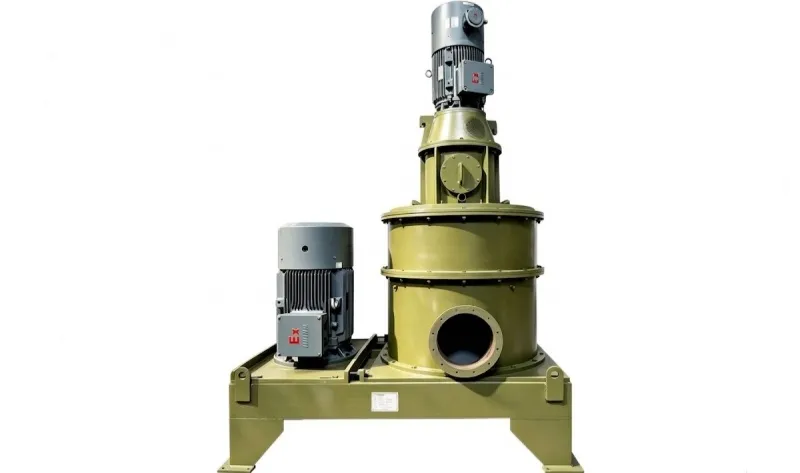
Grinding is a vital step in powder coating production. Flakes from the extruder are cooled, crushed, and then ground into fine powder using an air classifying mill (ACM). The ground particles are classified by a cyclone separator, sieved, and finally collected as finished product.
Whether the particle size and distribution meet requirements depends primarily on the grinding equipment. Today, the ACM milling system is widely used across the industry. The ACM mill features a compact structure, efficient classification, near-spherical particle shaping, and high output. By properly controlling the feeding rate of the screw feeder, the main and classifier mill speeds, and the cyclone seal integrity, manufacturers can achieve optimal particle size and distribution.
How Do Main and Classifier Mill Speeds Influence Grinding?
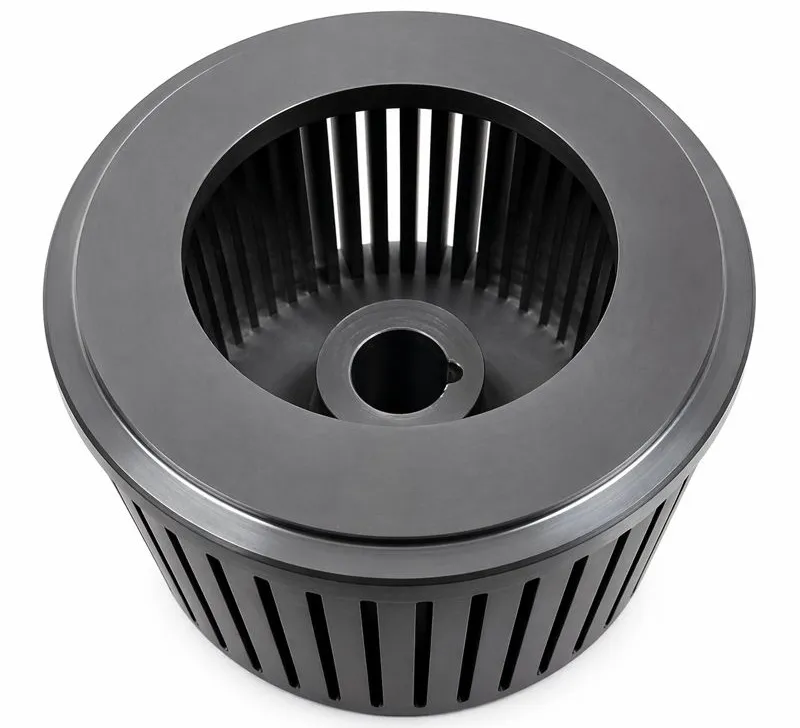
The main rotor disc is fitted with impact pins or hammers. As the rotor turns at high speed, raw flakes collide with the pins and with each other, shattering into fine particles. Centrifugal force and impact drive these particles toward the inner wall of the mill. An ascending airflow then carries them up toward the classifier rotor.
During classification, larger particles experience greater centrifugal force and are thrown back toward the inner wall for further grinding. Finer particles are carried through the classifier blades by the air stream into the cyclone separator and rotary sieve.
The tip speed of the main rotor directly affects particle size. Higher tip speeds increase both the force and frequency of particle impacts, resulting in finer powder. Conversely, lower speeds reduce collision energy, producing coarser powder while increasing mechanical resistance inside the mill.
The clearance between the main rotor tip and the mill cover also plays a role. A large gap allows particles to bypass classification, increasing the proportion of coarse powder. A tight gap increases ultrafine content. Maintaining a clearance of 2 mm to 3 mm is generally ideal.
Classifier speed is another critical factor. Driven by centrifugal force, higher classifier speeds prevent coarser particles from passing upward, thereby refining the overall particle size. Slower classifier speeds allow coarser particles to pass, resulting in a coarser product. Operators must adjust classifier speeds based on customer specifications and product types.
How Do Feeding Rate and Mill Temperature Play a Role?
The feeding rate determines the quantity of material inside the grinding chamber at any given moment, as well as the dwell time of flakes within the mill. At higher feeding rates, the main rotor speed exerts the greatest impact on grinding fineness, while classifier speed plays the decisive role in controlling particle size distribution.
How Do Cyclone Separators and Draft Fans Work Together?
Air carries the ground powder into the cyclone separator for gas-solid separation. As the air swirls inside the cyclone, its velocity drops. This causes powder particles to collide with the inner wall and settle out. Approved particles pass through a rotary valve (airlock) into the rotary sieve for final screening. Ultrafine particles remain suspended and travel to the dust collector.
Air tightness at the rotary valve is crucial. Significant air leaks disrupt the cyclone’s vortex airflow. This reduces separation efficiency and causes an excess of ultrafine powder to enter the finished product.
Because air acts as the transport medium during grinding, air volume directly impacts performance. Excessive air volume leads to a higher proportion of coarse particles. Insufficient air volume increases fine powder content and causes temperatures inside the mill to rise.
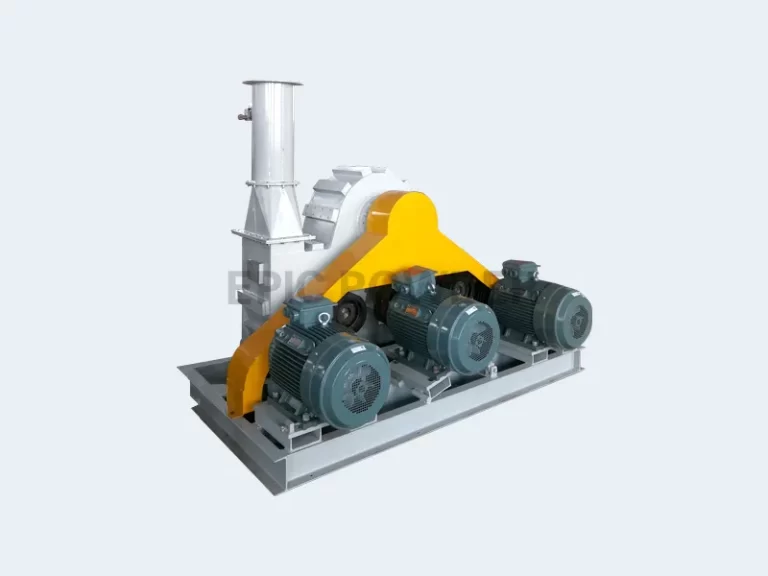
Airflow is managed using the draft fan damper. Operators adjust the damper based on feeding rate, powder fineness, and fan motor current load. Closing the damper minimizes fan current, while opening it increases current. System leaks also raise fan current. Monitoring current levels helps detect air leaks and keeps the system running stably.
Air leaks above the rotary valve, clogged pulse filter bags, or blocked inlet air filters all reduce effective airflow. This increases mill load, widens particle size distribution, and boosts ultrafine powder content. If heavy leaks occur at the rotary valve, cyclone, or duct joints, fine powder generation increases noticeably. Regular inspection is necessary to keep all connections airtight.
How Does Powder Coating Formulation Affect Particle Size?
Powder coating formulas typically consist of film-forming resins, pigments, fillers, and additives. In practice, resin selection and filler content strongly influence particle size and distribution.
Resin type and filler loading directly determine the room-temperature toughness of extruded flakes. Tougher flakes resist shattering, making them harder to grind. When processed through the same grinding system, tougher flakes yield fewer fine particles (below 10 µm) at comparable average particle sizes.
Conclusion
In conclusion, particle size and distribution significantly affect the application performance and final film properties of powder coatings. In production, manufacturers can adjust particle size and distribution by fine-tuning grinding parameters and formulation design. Optimizing main and classifier mill speeds, system pressure, and airflow helps balance production efficiency with a well-controlled particle size distribution.