목차

에어젯 밀을 이용하여 단결정 삼원계 재료의 "응집" 문제를 극복하는 방법은 무엇인가?

In the field of modern lithium battery materials, single-crystal ternary materials—such as LiNiₓCoᵧMn₁₋ₓ₋ᵧO₂—have become a major focus for power battery cathodes. They are highly valued for their excellent cycle stability, high energy density, and safety. However, as material particle sizes continue to be refined for higher performance, these materials commonly face the issue of “agglomeration” during handling, storage, and preparation. Using a Ternary Materials 에어젯 밀 offers a feasible and efficient solution for breaking up these agglomerates, improving both powder dispersibility and coating uniformity while preventing performance degradation and production inconsistencies.

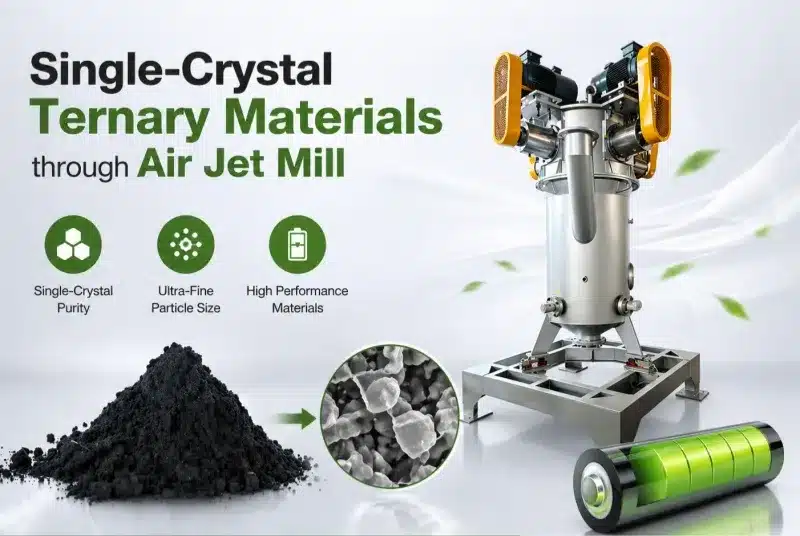
The air jet mill has been widely applied in ultrafine powder processing in recent years. It offers a feasible solution for breaking up these agglomerates. This article explores how to use Ternary Materials 에어젯 밀 technology to overcome these challenges by examining agglomeration mechanisms, working principles, and process optimization.

I. Causes of Agglomeration in Single-Crystal Ternary Materials

Before discussing solutions, it is necessary to understand why single-crystal ternary materials tend to agglomerate. Agglomeration is the phenomenon in which powder particles form clusters at microscopic or macroscopic levels, essentially due to adhesion or bonding between particles. For single-crystal ternary materials, the main causes include:

  1. High surface energy and moisture adsorption
    Single-crystal NCM materials have relatively high surface energy. Finer particles are more prone to Van der Waals attraction, leading to agglomerate formation. In addition, if the material adsorbs moisture from the air during storage or processing, a small amount of surface hydroxide may form, further increasing interparticle attraction.
  2. Particle morphology and size distribution
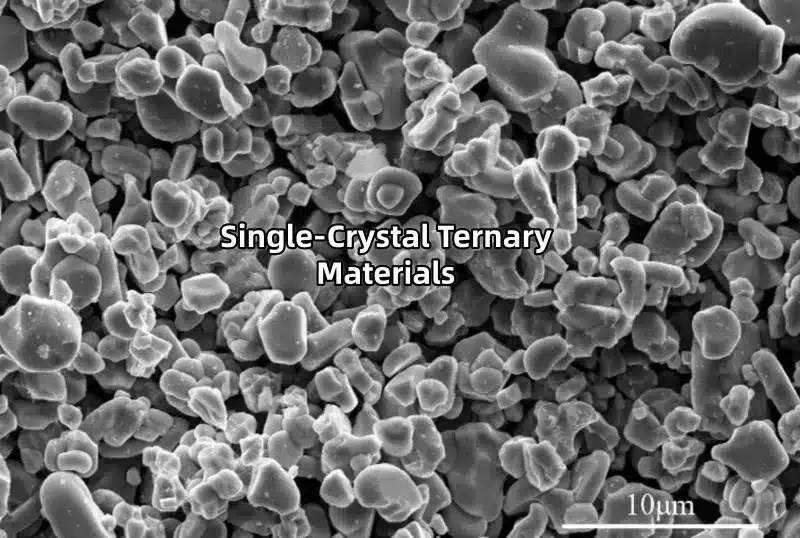
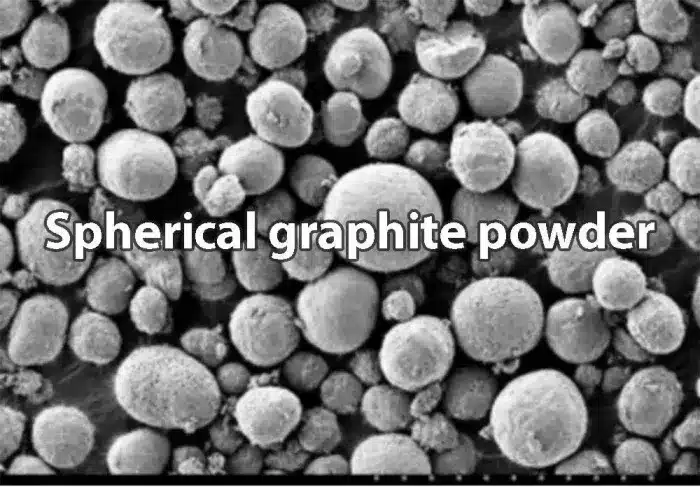
    Single-crystal materials are usually spherical or near-spherical, with small and narrow particle size distributions. Such particles easily form dense agglomerates during stacking, especially in humid or electrostatically charged environments.
  3. Residual stress from production processes
    During raw material preparation and processes such as ball milling or spray drying, single-crystal particles may develop surface defects or internal stresses. These defects increase surface roughness, making particles mechanically interlock more easily upon collision or vibration, forming agglomerates.
  4. Electrostatic and frictional effects
    Ultrafine particles tend to generate static electricity during transport, packaging, or mixing. Electrostatic forces, combined with interparticle friction, contribute to the formation of stable agglomerates, negatively affecting powder flow and uniformity.

Fundamentally, solving the agglomeration problem requires reducing interparticle adhesion, controlling particle size distribution, and improving flowability. Traditional mechanical methods, such as ball milling or vibration milling, can reduce particle size. However, they may also introduce microcracks, lattice damage, or performance degradation in ultrafine powders. In contrast, the Ternary Materials Air Jet Mill, with its unique aerodynamic milling mechanism, has become an effective tool to address this challenge.

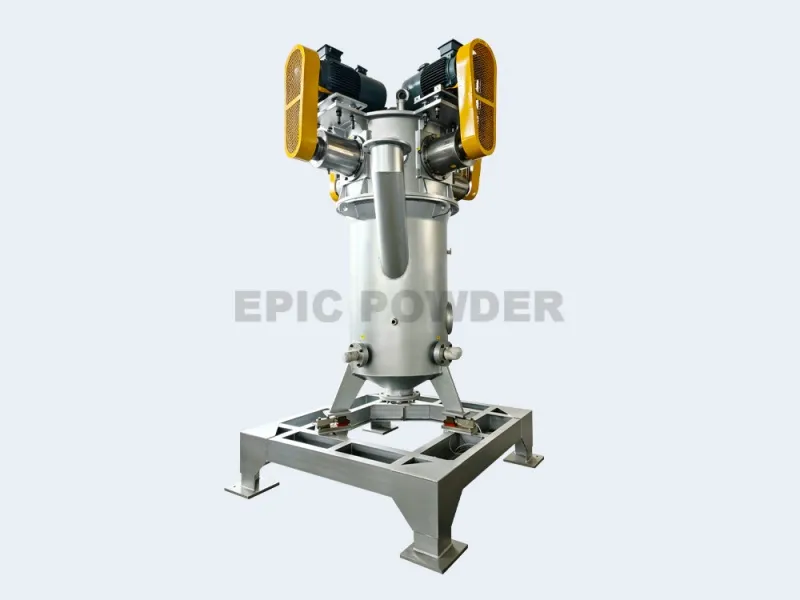
제트 밀 MQW-60-1

II. Working Principles and Advantages of Air Jet Milling

An air jet mill is an ultrafine powder processing device that relies on high-speed airflow to achieve milling. The core principle involves using high-pressure airflow within the milling chamber to generate high-speed impact and shear. This causes particles to collide, rub, and fracture, thereby achieving ultrafine grinding. At the same time, the equipment features an efficient 분류 system. This system continuously separates particles that meet the target size, while returning unqualified particles to the chamber for further grinding. Its main features and advantages are as follows:

  1. Non-contact or low-wear milling
    Air jet mills rely on high-speed airflow rather than grinding media, avoiding mechanical stress introduced by traditional ball or bead mills. This is particularly important for maintaining the integrity of single-crystal ternary materials and reducing microcrack formation, while also minimizing equipment wear and cross-contamination.
  2. High-efficiency classification and precise particle size control
    The built-in classification system allows precise adjustment of the particle size output according to rotor speed and airflow velocity. For single-crystal ternary materials, this means achieving narrow particle size distribution while effectively reducing the likelihood of agglomeration.
  3. Strong airflow impact to break agglomerates
    Agglomerates are often formed by fine particles sticking together through Van der Waals or electrostatic forces. The high-speed airflow and pneumatic circulation in an air jet mill can strongly impact and shear the agglomerates, dispersing them into individual particles and significantly improving powder dispersibility.
  4. Dry processing, reducing moisture absorption and contamination
    Air jet milling is generally a dry process, avoiding the impact of water or organic solvents on the material surface and reducing powder moisture absorption and oxidation risk. This is crucial for NCM single-crystal materials, as it prolongs shelf life and maintains electrochemical performance.

III. Process Strategies for Overcoming Agglomeration with Air Jet Mill

In practical applications, using an air jet mill alone does not fully guarantee the resolution of agglomeration; process optimization based on material characteristics is also required. Key strategies include:

1. Optimizing airflow velocity and pressure

The milling effect of an air jet mill is mainly influenced by airflow velocity and pressure. For severely agglomerated single-crystal ternary materials, medium-to-high-pressure airflow should be selected to ensure sufficient collision and shear energy within the milling chamber. Excessively high airflow may cause particles to collide excessively and create microcracks, so a balance must be found experimentally.

2. Adjusting classifier rotor speed

그만큼 분류기 rotor determines the particle size that can be discharged. High-speed rotors can screen finer powders, but excessive speed may increase circulation time, leading to static buildup and agglomeration. Proper rotor speed adjustment balances milling and classification, effectively controlling final particle size while reducing agglomeration.

3. Airflow path design and circulation system

Air jet mills typically use a closed-loop circulation system to return unqualified particles to the milling chamber. Proper airflow path design increases particle collision frequency, improving agglomerate breakage while preventing re-agglomeration in the transport pipeline.

4. Controlling material feeding methods

Particle morphology and moisture content directly affect agglomeration probability. Using uniform, continuous feeding avoids prolonged stacking in the hopper, reducing static accumulation and agglomerate formation. Pre-treatment such as drying or pre-classification can further optimize milling results.

5. Adding dispersants as auxiliary

In some high-performance applications, a small amount of surface modifier or dispersant can be added before or after air jet milling. These substances coat the particle surface, reducing surface energy and static forces, keeping the powder well-dispersed during storage and subsequent processing, further overcoming agglomeration issues.

IV. Practical Cases of Air Jet Mill Single-Crystal Ternary Materials

Ternary Materials Air Jet Mill has been successfully applied in several domestic and international power battery cathode material companies. For example, one manufacturer used an air jet mill to reduce the particle size of single-crystal NCM material from 10–20 μm to 2–5 μm. After milling, the powder exhibited uniform bulk density and improved flowability. In coating processes, slurry dispersibility improved, coating thickness uniformity increased, and battery capacity retention improved by more than 5%. This case clearly demonstrates the effectiveness of air jet milling in addressing the agglomeration problem of single-crystal ternary materials.

V. Conclusion and Outlook

The agglomeration of single-crystal ternary materials is a long-standing challenge stemming from particle fineness, high surface energy, and electrostatic adsorption. Ternary Materials Air Jet Mill provides a specialized solution through its high-speed airflow and classification mechanism. This process effectively breaks down agglomerates and controls particle size distribution. Consequently, it improves powder flow and dispersibility while maintaining the structural integrity of the material.

By optimizing parameters like airflow velocity, classifier rotor speed, and feeding methods—often combined with dispersants—air jet mill offers a highly controllable processing solution. In the future, as battery materials move toward higher energy densities, this technology will continue to evolve. Future optimizations will likely include intelligent control, online particle size monitoring, and low-temperature milling. These advancements will ensure the stable production of high-performance lithium batteries and provide guidance for the entire advanced energy materials sector.


에밀리 첸

“"읽어주셔서 감사합니다. 제 글이 도움이 되었으면 좋겠습니다. 아래에 댓글을 남겨주세요. 추가 문의 사항이 있으시면 젤다 온라인 고객 상담원에게 문의하셔도 됩니다."”

— 게시자 에밀리 첸
문의하기

당사 전문가가 6시간 이내에 연락하여 기계 및 프로세스에 대한 귀하의 요구 사항을 논의해 드립니다.

    다음을 선택하여 인간임을 증명하십시오. 자동차.

    관련 게시물