I. Ball Milling Process
The ball milling process, as a core technology for processing ceramic raw material powders, directly impacts the final product's key performance indicators, such as sphericity, through its mechanism of action on the powder's susceptibility to forces.
1.Basic working principle and macroscopic mechanism of 볼밀
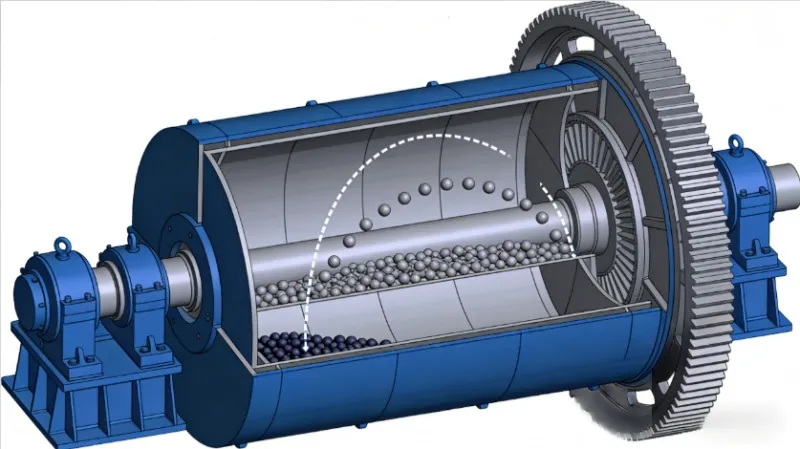
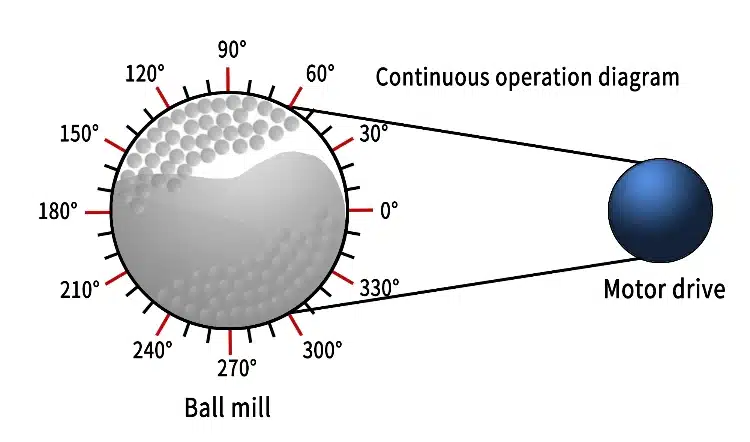
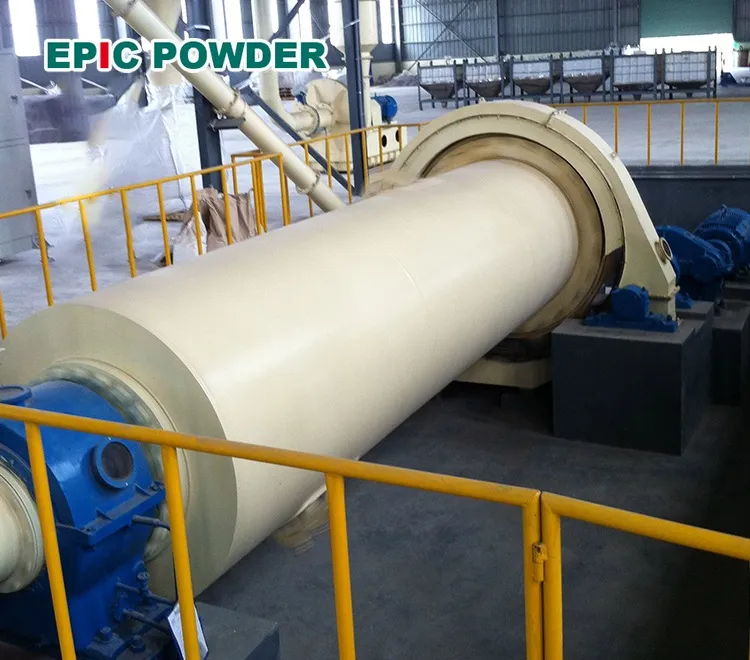
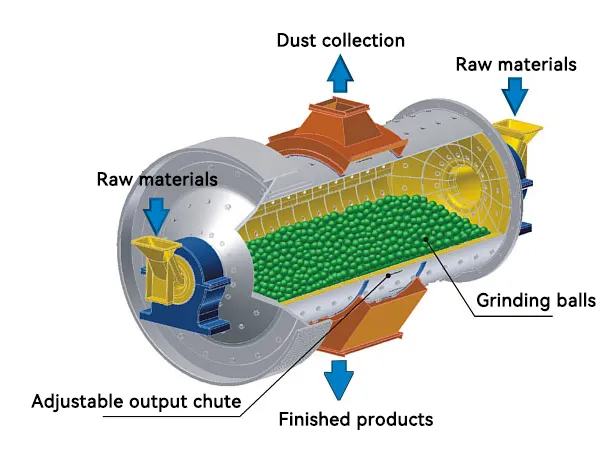
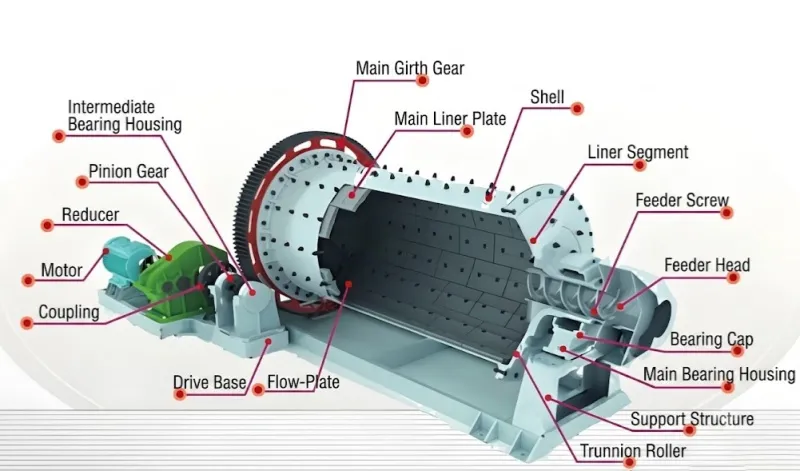
The ball mill drives the internal media (such as zirconia balls, alumina balls, etc.) to generate centrifugal motion through a rotating cylinder. As the cylinder rotates, the media are lifted to a certain height and then fall freely, generating strong impact force and grinding action. This process is accompanied by mutual collisions between the media and friction between the media and the cylinder wall. This causes the material particles to undergo breakage, refinement, and morphological reconstruction under the action of multiple force fields. During ball milling, the particle size distribution and shape characteristics exhibit periodic fractal dimension changes. This is closely related to the media's trajectory and energy transfer efficiency.

2. Complex Mechanical Environment and Forces of Powder Particles
The mechanical environment experienced by powder particles during ball milling is extremely complex. Impact force mainly originates from the kinetic energy transfer of the moving medium, and its intensity is positively correlated with the medium size, filling rate, and cylinder rotation speed. Shear force originates from the tangential stress generated by the relative sliding between medium layers, causing plastic deformation of particles along specific crystal planes. Friction acts on the interface between particles and the medium/cylinder, leading to localized shearing or spalling of the surface layer.
3. Synergistic Effects of Multiple Forces and Particle Morphology Evolution
The synergistic effects of these three types of forces determine the particle breakage mode and morphology evolution path. Moderate impact energy can induce brittle fracture, forming regular fragments. Excessive shearing and friction, however, can lead to edge wear or agglomeration of particles, thus reducing sphericity. When the ball milling time exceeds a critical value, the resin matrix structure of non-metallic particles may be damaged; this phenomenon also requires attention in ceramic raw material processing. Excessive refinement may cause non-uniform deformation or lattice distortion in the particles, leading to deterioration in sphericity.

4. Microscopic Fracture Mechanism and Numerical Simulation Methods
Microscopic stress analysis reveals that particle fragmentation follows the classic fracture mechanism of “stress concentration – crack initiation – propagation – fracture”. Impact loads induce localized stress fields within the particles. When the stress intensity factor exceeds the material’s fracture toughness, cracks propagate along grain boundaries or defects. Shear stress, on the other hand, induces slip deformation in the particles, leading to ploughing or microcracks on the surface. The Discrete Element Method (DEM) combined with a non-spherical particle model can effectively simulate this process. By assigning anisotropic contact parameters to the particles, the influence weights of different force systems on sphericity can be quantified. When the impact energy accounts for 60%-70% of the total input energy, brittle fracture dominates, which is conducive to the formation of near-spherical particles. However, when the shear energy proportion is too high, it exacerbates the wear of particle edges, leading to a decrease in sphericity.
5. Energy Conversion Efficiency and Process Control Strategies
Energy conversion efficiency is a core parameter affecting ball milling performance. In a ball mill system, mechanical energy is mainly converted into particle crushing work, media wear heat, and frictional heat. The effective mechanical energy generated by a single media-particle collision can reach 1.234 × 10⁻³ J, which directly participates in the particle crushing process. Precise control of energy input can be achieved by adjusting the cylinder rotation speed and filling rate. For example, using variable frequency drive technology allows the ball mill to match the optimal rotation speed at different stages, ensuring impact crushing efficiency while reducing the negative impact of over-grinding on sphericity. Furthermore, a media size-based tiered filling strategy can form a multi-stage crushing system. Large-sized media provide the main impact energy, while small-sized media undertake the fine grinding task. This tiered action mode is beneficial for achieving synergistic optimization of particle size and morphology.
6. Sphericity Control Theory and Auxiliary Optimization Methods
At the level of sphericity control theory, fractal geometry and energy models provide important analytical tools. The fractal dimension of particle morphology can characterize its surface roughness and geometric irregularity. Studies have shown that as the ball milling time increases, the fractal dimension of ceramic powder exhibits a trend of first increasing and then decreasing. In the initial stage, the breakage of particle edges increases the dimension; after reaching the critical time, excessive wear leads to a decrease in the dimension. Combined with energy analysis, the sphericity of the powder can reach the optimal value when the ratio of the total system input energy to the material fracture work is in the range of 1.2-1.8.

II. Evaluation of Powder Sphericity
1. Microscopic Evolution Characteristics of Powder Morphology During Ball Milling
In the ball milling process, the crushing and reorganization of raw material powder particles under mechanical force leads to significant changes in their surface morphology. For example, during ball milling, the local atomic arrangement in the graphite structure transforms from a graphitic shape to a disordered tetrahedral network. This process is accompanied by an increase in the number of quintillary faces in the Voronoi polyhedron (VP). The decrease in its sphericity coefficient Ksph directly reflects the degradation of particle sphericity. This change in topological characteristics not only reflects the degree of disorder in the microstructure but also provides a quantitative basis for the dynamic evolution of powder morphology.
2. Multidimensional Evaluation Indicators and Calculation Methods for Sphericity
Regarding evaluation criteria, the sphericity coefficient Ksph has been proposed as a parameter for topological order. The orderliness of local atomic arrangements is quantified by analyzing the topological and metric characteristics of the Voronoi polyhedron. Ksph is calculated based on the curvature distribution of the faces of a polyhedron. The closer its value is to 1, the closer the particle is to an ideal sphere. This parameter is particularly suitable for analyzing the evolution of powder morphology during high-energy ball milling. It can effectively distinguish the degree of particle breakage under different ball milling times or energy inputs.
III. Factors Affecting Sphericity
Powder sphericity is a crucial indicator for evaluating the performance of ceramic raw material powders. It directly impacts the efficiency and product quality of subsequent sintering and molding processes. In ball milling, controlling powder sphericity involves the synergistic effect of multiple factors. Among these, ball milling time, rotation speed, media selection, raw material characteristics, and dispersion process are the core influencing factors.

1. The Influence of Ball Milling Time on Particle Morphology and Dispersibility
Ball milling time directly affects the plastic deformation and degree of fragmentation of particles. When the grinding time of a certain powder is controlled at 6 hours, the powder achieves sufficient fragmentation while effectively avoiding morphological distortion caused by over-fragmentation. At this time, nanoparticles can be uniformly dispersed on the surface of large particle matrix particles, while maintaining the sphericity of the matrix particles. Too short a ball milling time will lead to insufficient energy input between particles, making it difficult to achieve a fully rounded morphology. Too long a ball milling time may cause the propagation of microcracks on the particle surface due to repeated collisions, or even lead to agglomeration.
2. Matching Relationship Between Mill Rotation Speed and Collision Energy
The mill rotation speed directly affects the powder morphology by regulating the collision kinetic energy between particles and the media. For example, at a rotation speed of 250 rpm, the collision frequency and energy distribution between particles and media within the mill reach a balanced state. This achieves effective particle crushing while avoiding excessive kinetic energy concentration due to high-speed collisions, thus maintaining particle sphericity. Furthermore, excessively high rotation speeds may cause non-uniform wear between the media and particles, while excessively low rotation speeds may fail to induce sufficient plastic deformation, resulting in poor sphericity.
3. Optimization of Media Parameters and Control of Energy Transfer Efficiency
Media selection includes material, size ratio, and filling ratio. Optimizing the ball-to-powder weight ratio (e.g., 1:3:2) can adjust the collision probability and energy transfer efficiency between the media and powder, avoiding localized over-grinding due to overly dense media or insufficient crushing due to overly sparse media. The hardness of the media material must match the raw material particles to avoid scratching the particle surface due to excessively hard media, or exacerbating particle contamination due to excessively soft media. The graded combination of media particle sizes can create a more uniform energy distribution, promoting isotropic deformation of particles.
4. The Fundamental Role of Initial Raw Material Characteristics in Sphericity
The initial particle size and loose density of the raw material powder have a significant impact on sphericity control. Raw materials with excessively large initial particle sizes are prone to insufficient crushing during ball milling. Conversely, excessively small particles may agglomerate due to excessively high surface energy, affecting subsequent sphericity formation.

“"읽어주셔서 감사합니다. 제 글이 도움이 되었으면 좋겠습니다. 아래에 댓글을 남겨주세요. 추가 문의 사항이 있으시면 젤다 온라인 고객 상담원에게 문의하셔도 됩니다."”
— 게시자 에밀리 첸