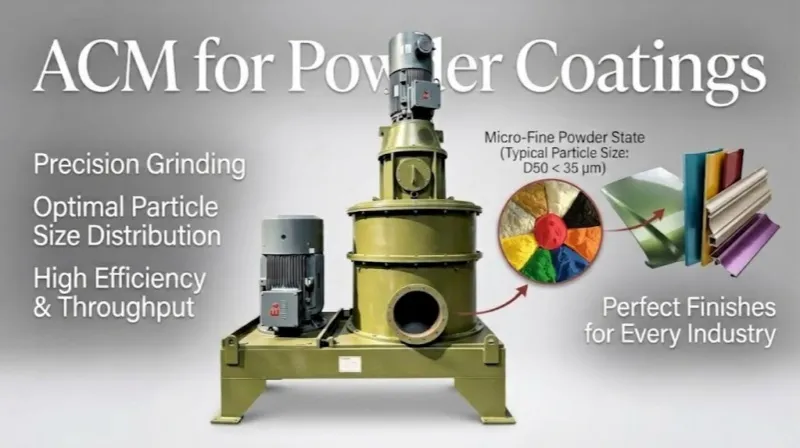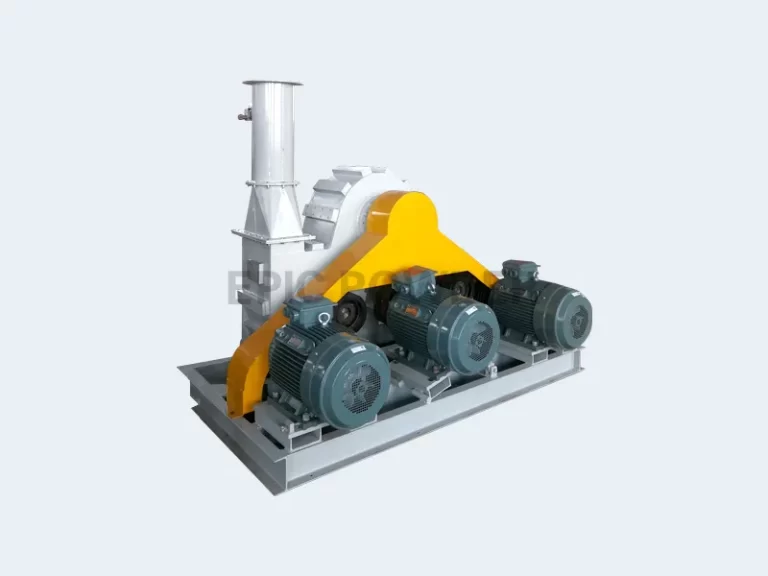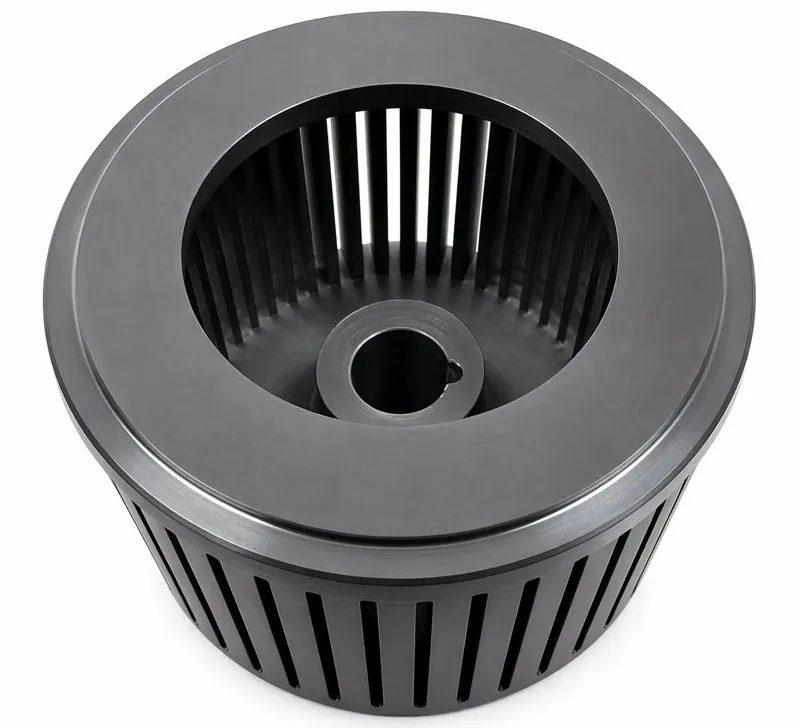
In fine chemicals, coatings, plastics, lithium batteries and inorganic non-metallic materials, ultrafine powders such as silica, quartz, calcium carbonate and talc are foundational raw materials. Yet a persistent problem undermines their value: agglomeration. Two particles that should move freely instead cluster into secondary particles, degrading flow, dispersion, optical properties, mechanical strength and storage stability. This guide explains why ultrafine powders agglomerate, what “deagglomeration” really means, and how two workhorse machines — the pin mill and the jet mill — are used to solve it in dry-process production.
1. Agglomeration vs Dispersion: Why It Matters
Agglomeration and dispersion are opposing interfacial behaviours. In a gas or liquid phase, particles that attract each other form clusters — agglomerates — while particles that remain independent and free-moving are said to be dispersed. For downstream products, dispersion quality directly determines microstructure, mechanical performance, optical clarity and shelf life. Whether the material is a nanoscale powder, a sub-micron inorganic filler or a functional mineral powder, stable dispersion is often the difference between a successful process and a failed one.
Three states of agglomerates
By the nature of the inter-particle bond, agglomerates fall into three categories:
- Cohesive bodies (,hard agglomeration) — primary particles joined face-to-face; the total surface area is far smaller than the sum of the individuals. These are hard agglomerates and are very difficult to re-disperse.
- Agglomerates (soft agglomeration) — particles joined at points or corners, or fine particles attached to larger ones. Total surface area is larger than a cohesive body but smaller than the free particles. These are soft agglomerates and are comparatively easy to re-disperse — the main target of deagglomeration equipment.
- Flocculates — loose, cotton-like structures formed by polymer bridging or high-molecular surfactants; inter-particle distance is much larger than in the other two types.
The practical takeaway: hard agglomeration must be avoided upstream during synthesis and drying, because once formed it is nearly impossible to undo. Soft agglomeration is exactly what mechanical deagglomeration is designed to reverse.
2. Why Ultrafine Silica and Quartz Powders Agglomerate in Air
In dry air, three inter-particle forces dominate: Van der Waals force, electrostatic force and liquid-bridge force. Of these, electrostatic force is much smaller than the other two. Agglomeration is mainly driven by liquid bridges under humid conditions, and by Van der Waals force under very dry conditions.
- Humidity is the critical switch. When relative humidity exceeds roughly 65%, moisture readily condenses on particle surfaces and in the gaps between particles, forming liquid bridges that sharply intensify agglomeration. Keeping the powder dry is therefore one of the simplest and most effective anti-agglomeration measures.
- Finer means stickier. As particle size drops into the sub-micron range, specific surface area and surface energy rise dramatically, so Van der Waals attraction grows relative to particle mass — nanopowders and ultrafine quartz flour are notoriously cohesive.
- Process history matters. Filter-press dewatering, drying and storage can all convert a well-dispersed powder into a caked, agglomerated one.
This is why a deagglomeration line is rarely just one machine: it is typically combined with drying, classification and — for many mineral fillers — surface modification. Our project page on high-performance silica surface modification shows how dispersion and surface treatment are integrated in practice.
3. What “Powder Deagglomeration” Actually Requires
Deagglomeration is not the same as size reduction (grinding). Grinding aims to fracture primary particles and move the D50 downward; deagglomeration aims to separate secondary particles back into primary particles without over-grinding or contaminating them. The core condition is simple: apply a mechanical stress that exceeds the adhesion holding the agglomerate together, but stay below the fracture strength of the primary particle wherever possible.
In dry systems this is achieved by impact, shear and turbulent stress. The limitation of purely mechanical dispersion is equally clear: it is a passive, forced approach — the intrinsic surface forces are unchanged, so once the powder leaves the high-shear zone it can re-agglomerate. It can also cause over-comminution of brittle powders and continuous equipment wear. For that reason, industrial practice couples mechanical deagglomeration with drying (to remove liquid bridges) and, where needed, surface modification (to weaken attraction). For a broader overview of surface-treatment routes, see 14 ultrafine powder coating methods and equipment.
4. Pin Mill for Powder Deagglomeration

Pin mill — intermeshing pin discs generate impact and shear to break soft agglomerates.
The pin mill / disc pin mill is designed under the guidance of our German experts and is available in a single-drive series (moving disc + static disc) and a dual-drive series (moving disc + moving disc). Material is fed uniformly into the grinding chamber by the feeding system and is strongly impacted by the high-speed rotating grinding disc; between the pins it is subjected to friction, shearing, collision and other combined forces, so the material is ground or deagglomerated. Depending on the material properties, the grinding disc and the static disc can be combined in different structural forms to meet the grinding requirements of different materials.
Why it works for soft agglomerates
- High tip speed, controllable fineness: dual-power configurations can reach linear speeds above 200 m/s; fineness is adjusted by disc speed rather than by changing screens.
- No sieve, smooth discharge: high capacity and low operating cost, with easy cleaning by simply opening the grinding door.
- Gentle, selective break-up: impact and shear preferentially attack weak agglomerate bonds while largely preserving primary-particle morphology.
- Wide adaptability: suitable for grinding materials with high moisture, high oil content, stickiness and heat sensitivity.
Typical pin mill parameters span coarse (20–200 mesh, 75–85 m/s) through fine (60–300 mesh, 100–120 m/s) to ultrafine (100–2500 mesh, 200–240 m/s) operation. For silica and quartz fillers, the ultrafine regime is used to deagglomerate calcined or surface-treated powder before final classification. Pin mills are also the core of pin mill coating systems, where deagglomeration and surface coating happen together.
5. Jet Mill for Powder Deagglomeration
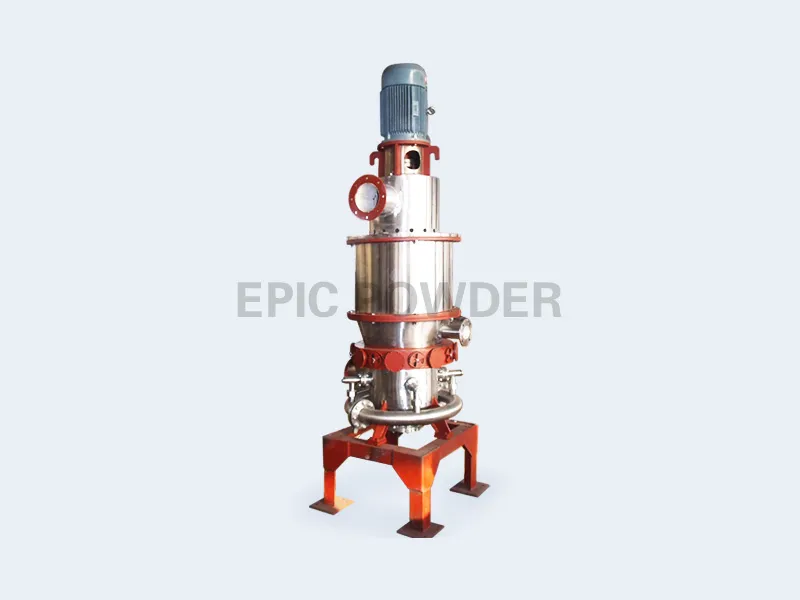
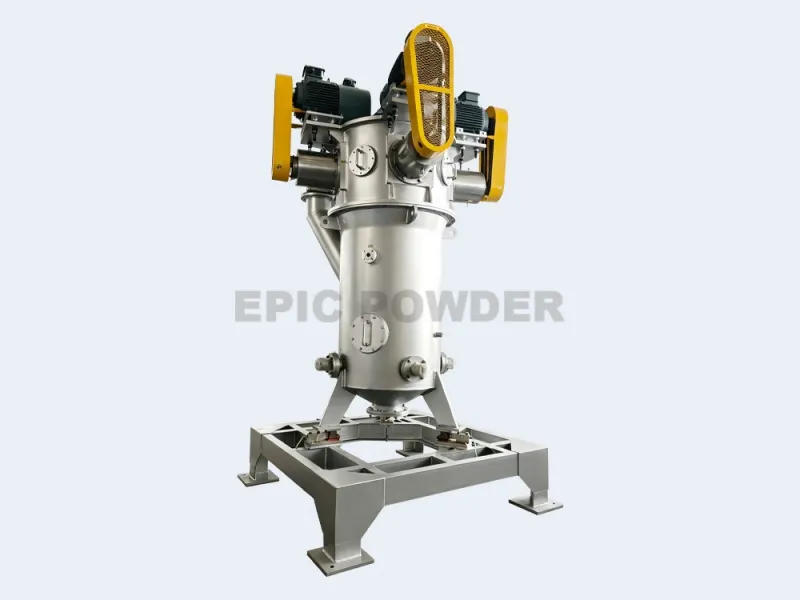
Fluidized-bed opposed jet mill — media-free particle-on-particle impact with integrated classification.
A jet mill uses high-speed compressed gas (air or nitrogen) as the energy source. Particles are accelerated to sonic or supersonic speed at the nozzles and collide with each other in the grinding chamber — there is no grinding media. Ground material rises into a classifier; qualified fines exit with the airflow while coarse particles are returned for further grinding.
Why it works for ultrafine, high-purity powders
- Media-free, low contamination: particle-on-particle impact avoids media wear — critical for high-purity silica and electronic-grade fillers.
- Low temperature rise: gas expansion cools the process, protecting heat-sensitive or surface-treated powders.
- Narrow, adjustable PSD: classifier speed and airflow precisely control D50/D97, effectively removing both hard lumps and loose fines.
- Continuous, enclosed operation: negative-pressure, dust-free and automation-ready, which also helps keep the powder dry.
Both fluidized-bed opposed jet mills and spiral jet mills are used for deagglomeration; the opposed-jet design typically delivers higher impact energy for the toughest soft agglomerates, while the spiral type suits heat-sensitive and softer materials. For context on operating cost, see our comparison of jet, impact, stirred and ball mill energy costs.
6. Pin Mill vs Jet Mill for Powder Deagglomeration
| Criterion | Pin Mill | Jet Mill |
|---|---|---|
| Break-up mechanism | Impact + shear between intermeshing pins and discs | High-speed particle-on-particle collision in gas flow |
| Typical fineness | Down to ~100–2500 mesh (ultrafine regime) | D97 adjustable in the low-micron range |
| Contamination | Low; wear surfaces can be minimized | Very low; no grinding media |
| Temperature rise | Moderate; disc cooling recommended | Low; gas expansion cools |
| Energy basis | Mechanical (electric drive) | Compressed gas (air/nitrogen) — higher utility cost |
| Best fit | Soft agglomerates, general minerals, coating lines | High-purity, heat-sensitive, narrow-PSD products |
| Integration | Easy to combine with coating | Easy to combine with air classification |
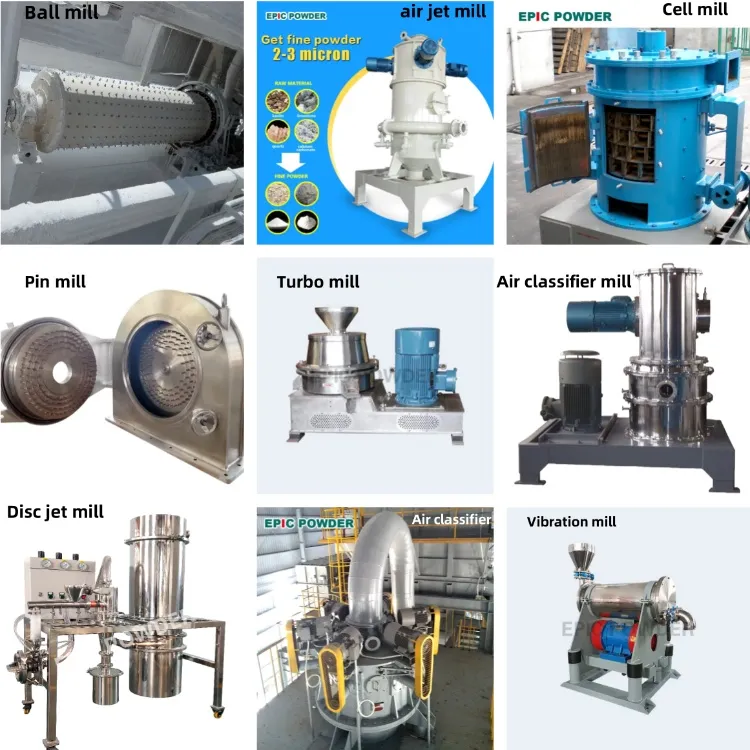
Rule of thumb: choose a pin mill when the priority is throughput, coating integration and cost-effective break-up of soft agglomerates; choose a jet mill when purity, low temperature rise and a tight particle-size distribution dominate. Both can be paired with a turbo double classifier or air classifier to remove any residual coarse fractions after deagglomeration.
7. Building a Complete Deagglomeration Line
Because single methods have limits, industry relies on coupled solutions. A robust dry deagglomeration line typically combines:
- Controlled drying — remove interstitial water to suppress liquid bridges at the source; multi-rotor dryer mills can combine drying with milling.
- Mechanical deagglomeration — pin mill or jet mill to break soft agglomerates.
- Precision classification — an air classifier or turbo classifier to cut off hard lumps and oversize.
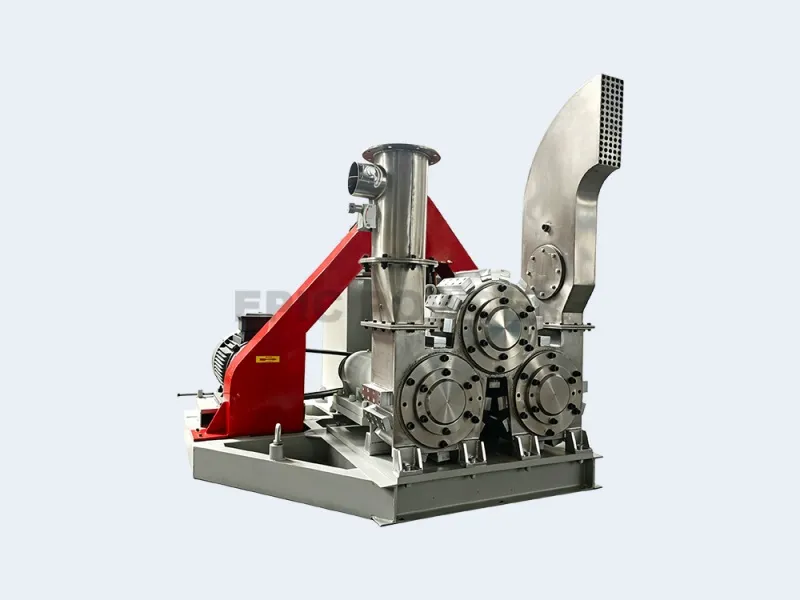
- Surface modification — physical coating or chemical grafting to weaken inter-particle attraction and stabilize dispersion long-term, using systems such as a three-roller modification machine.
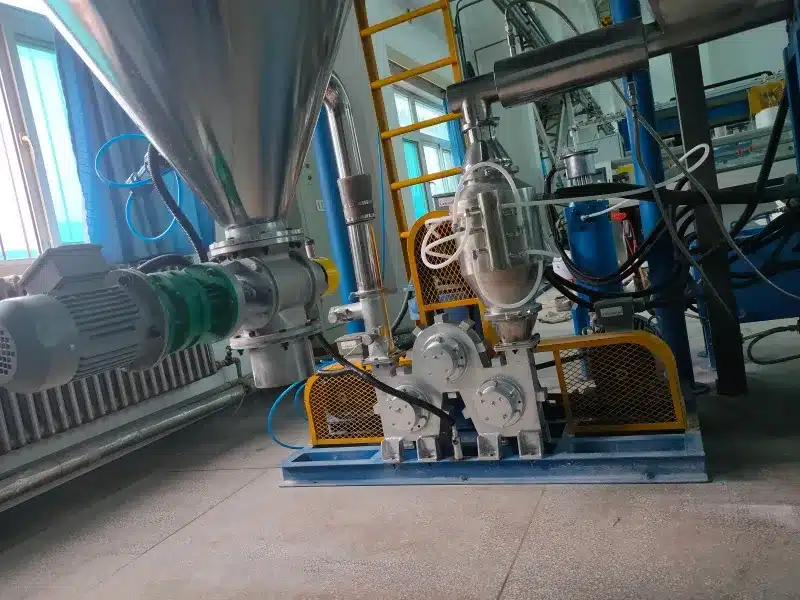
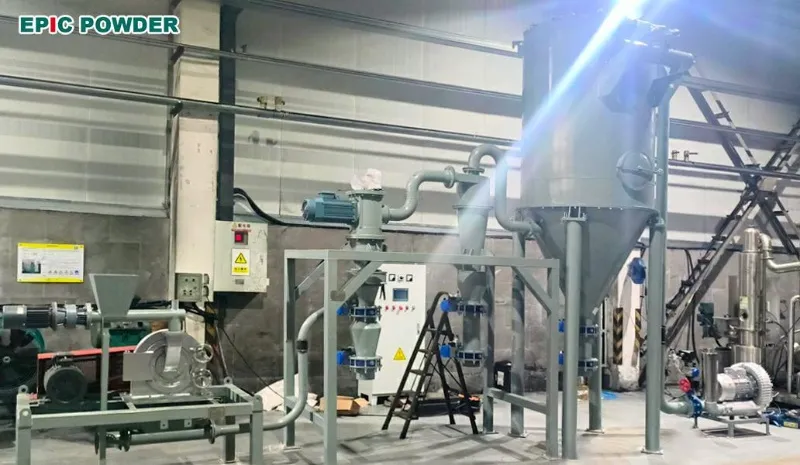
Integrated silica powder surface modification line — deagglomeration and dispersion stabilization in one process.
8. How to Choose the Right Deagglomeration Equipment
- Starting agglomerate type: soft agglomerates respond well to mechanical break-up; hard agglomerates must be prevented upstream.
- Purity requirements: for electronic-grade silica, media-free jet milling minimizes metallic contamination.
- Moisture sensitivity: if the powder is hygroscopic, prioritize enclosed drying + dry deagglomeration and control humidity below the liquid-bridge threshold.
- PSD target: tight distributions favour jet mills with precision classifiers.
- Downstream compatibility: for coating/plastics, a pin mill coating line can deagglomerate and surface-treat in one step.
Not sure which route fits your material? Talk to our process engineers — share your powder, target fineness and capacity, and we will recommend a configuration and run trials.
9. FAQ
Can deagglomeration replace grinding?
No. Deagglomeration separates secondary particles into primary particles; grinding fractures the primary particles themselves. They are complementary — grinding sets the particle size, deagglomeration restores dispersion.
Why does my powder re-agglomerate after deagglomeration?
Because the intrinsic surface forces are unchanged. Without drying and surface modification, powder leaving the high-shear zone can re-cluster. Coupled drying + coating is the standard remedy.
Is a jet mill always better than a pin mill?
No. Jet mills offer purity and precise PSD but consume significant compressed gas. For cost-effective, high-throughput break-up of soft agglomerates — especially on coating lines — a pin mill is often the better choice.
What humidity level should I control?
Because liquid bridges intensify above roughly 65% RH, keeping process and storage humidity well below that threshold is a practical first line of defence against agglomeration.

Jason Wang, Engineer
Connect with Jason on LinkedIn →
Thank you for reading. I hope my writing is helpful. Leave a comment below. Contact EPIC Powder Online Customer Service Agent for Powder. If you have any further questions, please get in touch.