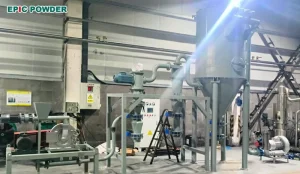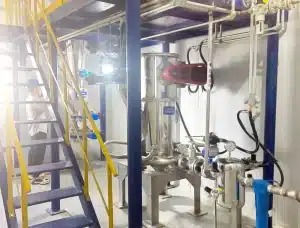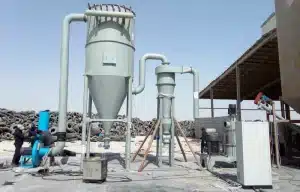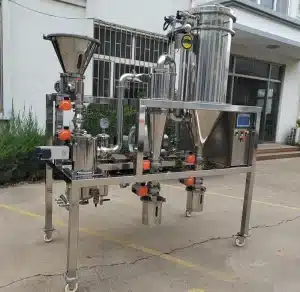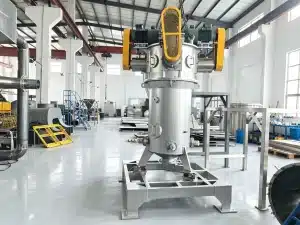
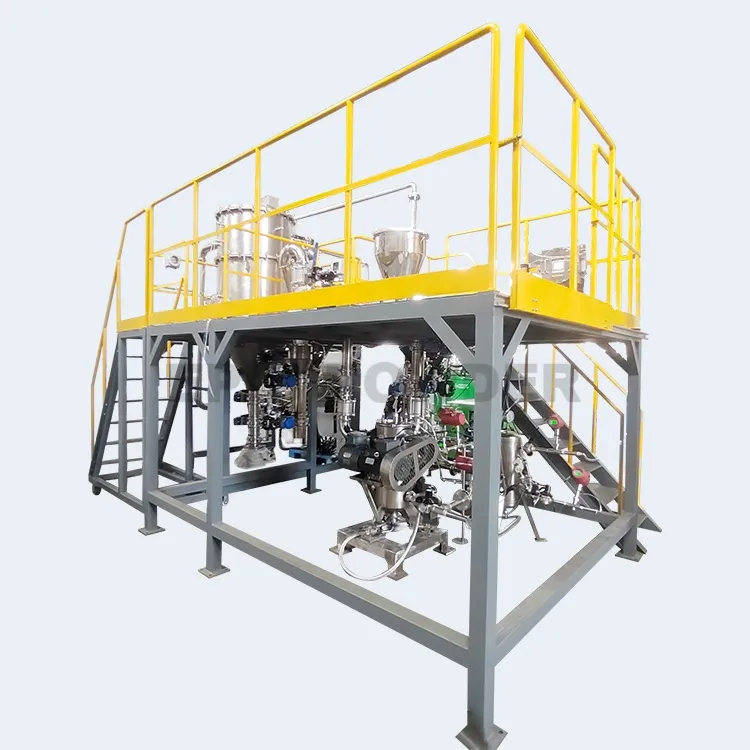
Neodymium iron boron (NdFeB) powder is highly sensitive to oxygen and heat. Conventional mechanical grinding can easily cause oxidation and metallic contamination. Recently, an overseas client asked Epic Powder to grind NdFeB feedstock with a D50 of about 270 μm down to a finished D50 of 11–15 μm. We supplied an MQW06 fluidized-bed opposed jet mill with a nitrogen circulation system, completing feeding, grinding, classification and collection under an inert atmosphere.
| Client & material | Overseas client · Neodymium iron boron (NdFeB) |
|---|---|
| Feed particle size | D50 approx. 270 μm |
| Target product size | D50 11–15 μm |
| Core equipment | MQW06 fluidized-bed opposed jet mill + nitrogen circulation system |
| Process goals | Oxidation control, low contamination, stable particle size distribution |

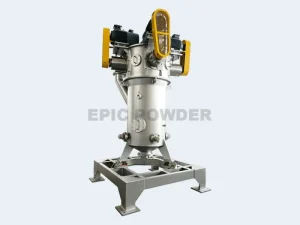
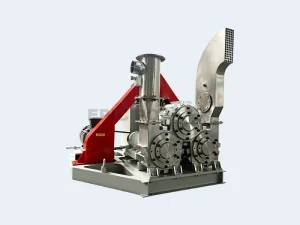
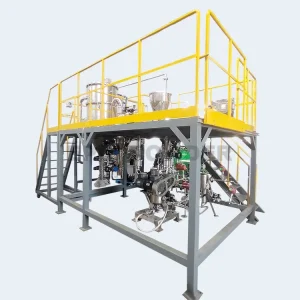
The MQW06 jet mill with nitrogen circulation system
The Challenge: Fine Grinding and Oxidation Control at Once
The finer the NdFeB powder, the larger its specific surface area and the higher the oxidation risk on contact with air. Oxidation directly weakens magnetic performance and destabilizes downstream sintering or bonding processes. The client set three clear requirements: a finished D50 consistently within 11–15 μm, no foreign matter from grinding media wear, and continuous operation in a low-oxygen environment without excessive protective-gas consumption.
The Solution: NdFeB MQW06 Jet Milling with Closed-Loop Nitrogen
To meet these requirements, we selected the MQW06 fluidized-bed opposed jet mill. Material is broken by high-speed particle-on-particle collisions and shear in jets accelerated through Laval nozzles. This self-grinding mechanism introduces almost no grinding media, making it well suited to high-value magnetic materials. An integrated high-efficiency turbo air classifier sits in the same housing: coarse particles return to the grinding zone while qualified fines move to the cyclone separator and dust collector. Adjusting classifier speed and airflow parameters locks the product size into the target window.
To suppress oxidation, the line is equipped with a nitrogen circulation system. Purified nitrogen enters the sealed circuit and is reused, maintaining low-oxygen conditions while reducing fresh gas consumption. The fully enclosed design also lowers dust escape and cross-batch contamination risks. See the machine dispatch video for the complete system before shipment.
Results and Process Value
After commissioning, the finished powder consistently reached the client’s target D50 of 11–15 μm, with controllable distribution and good batch-to-batch repeatability. Because the entire process ran under nitrogen protection, oxidation was effectively suppressed and the magnetic powder’s downstream performance was preserved. For the client, the line resolves fineness, purity and atmosphere protection on a single system, eliminating material transfers between separate machines.
For more on equipment selection, read our guide to jet milling process and equipment selection. Another purity-critical example is our US client case using an MQW03 lab jet mill for dental glass ceramics.
Conclusion
Ultrafine grinding of NdFeB is not simply about grinding finer; it is about balancing particle size, oxygen content and contamination control. The NdFeB MQW06 jet milling with nitrogen circulation offers a repeatable process route for magnetic materials. If you have a similar material to evaluate, please contact the Epic Powder engineering team for a tailored solution.

Thanks for reading. I hope my article helps. Please leave a comment down below. You may also contact Molly online customer representative for any further inquiries.